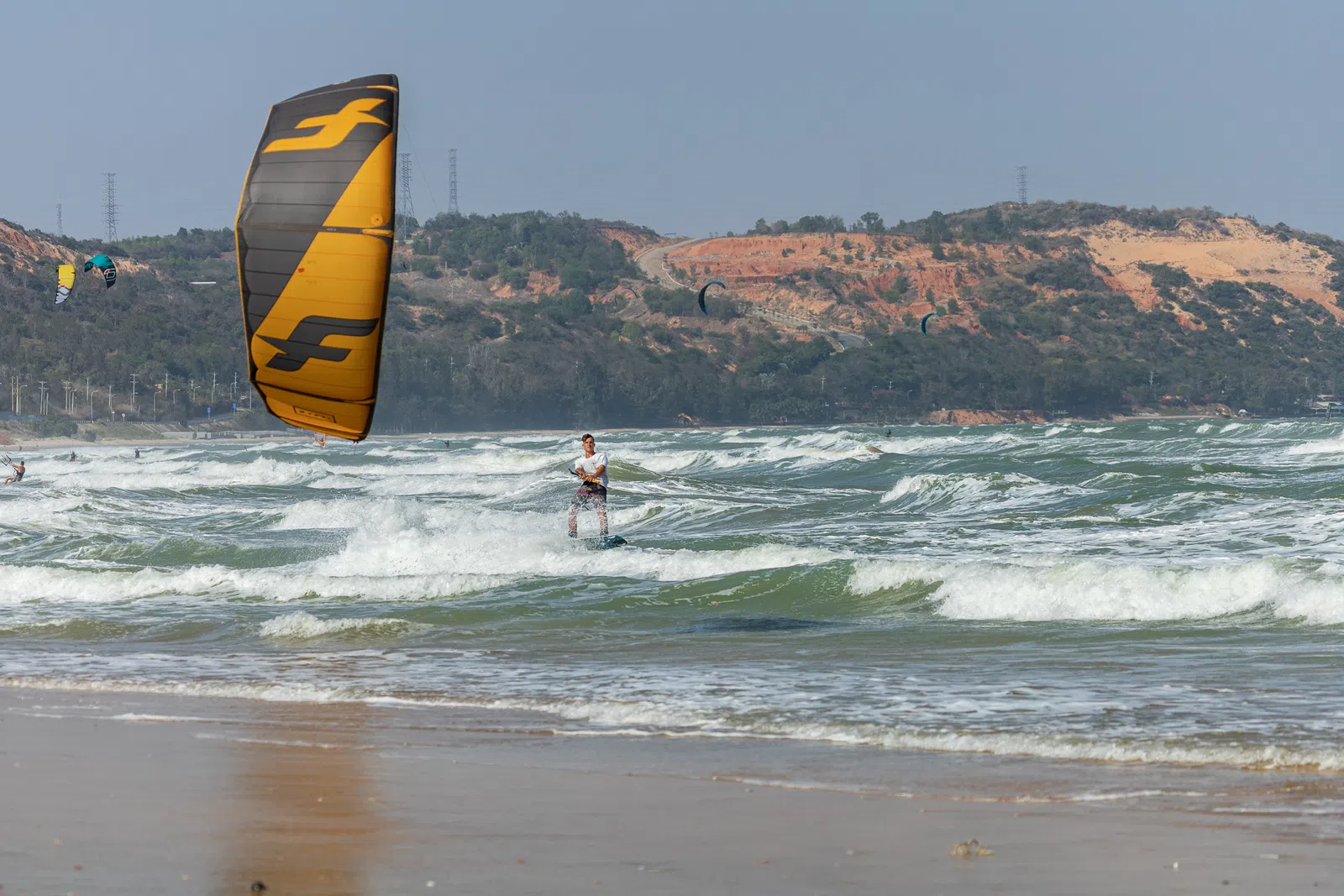
The honest answer: about 7–10 days and €400–700 to reach the point where you can ride independently. But there are details worth knowing, so let's go through them properly. We've been teaching kitesurfing in Mui Ne since 2006 and have seen hundreds of students — everyone learns differently, but the pattern is consistent.
How many hours it actually takes
IKO recommends 10–15 contact hours to reach a level where you can:
- control the kite confidently in the wind window;
- launch and land it yourself;
- water-start and ride your first metres;
- fall and recover without panic.
In practice many people manage in 8–10 hours if the conditions are good (12–15 knots) and they're reasonably fit. Here's how it usually looks in Mui Ne:
- Days 1–2: theory on the beach, kite control on land, first attempts in the water with the instructor — 6–8 hours.
- Days 3–4: independent kite control, body-drag, board recovery, first metres riding — 4–6 hours.
- Day 5: consolidation, longer rides, the beginnings of turns — 2–3 hours.
Intensive learning (several days in a row) shows results faster. Spread over weekends it takes longer — muscle memory fades between sessions.
What lessons cost at K1
Our actual prices in Mui Ne:
- One hour, private — €55. Includes all equipment, a radio helmet and equipment insurance.
- Group lesson 2:1 — from €45 per person per hour, roughly 25% cheaper than private. Same method, same gear.
- Discovery course (first introduction, IKO levels 1A–1E) — €100.
- Intermediate course (levels 2F–2I, water start and self-rescue) — €300, 6 hours plus an hour of free rental.
- Course 8+1 hours (Discovery + Intermediate) — €400.
- Independent course (levels 3J–3N) — €500.
- Full 15-hour course, zero to independent riding — €600, including an IKO certificate and free rental.
Mui Ne is one of the more affordable places in Asia to learn, thanks to reliable wind and healthy competition between schools. In Europe and the USA the same programme typically costs considerably more.
Other costs for a learning trip
- Accommodation: from around $40–80 a night depending on standard. Staying at Sandunes next to our station means no transfers — see our accommodation options.
- Food: $5–10 a day if you eat at local cafés.
- Your own gear: not needed while learning — it's all included in lessons. Buy afterwards, once you know what suits you.
Total for a course plus a week in Mui Ne: roughly €600–1,000 without buying equipment.
What makes learning faster — or slower
Faster: board sports experience (snowboard, wakeboard, surf), decent fitness, learning on consecutive days, steady wind of 12–18 knots.
Slower: long gaps between lessons, gusty or very light wind, trying to save money by cutting hours (paradoxically the most expensive approach — skills fade and you pay to relearn).
Should you buy gear straight away?
No. During a course everything is included, and across several sessions you'll try different kite sizes and work out what fits your weight and style. Buying before that usually means buying the wrong thing. When you're ready, we'll help you choose in the K1 shop — and see our guide to choosing your first kite.
Frequently asked questions
How much does it cost to learn kitesurfing in Vietnam?
At K1 a one-hour private lesson is €55, and courses run from €100 (Discovery) to €600 (the full 15-hour course to independent riding). Group lessons 2:1 start at €45 per person per hour. Gear, radio and equipment insurance are included.
How many days do I need?
Most people need 8–15 hours, which usually means 4–7 days of 1–2 hours matched to the wind. Booking a week gives you enough margin for a light-wind day or two.
Is it cheaper to learn in a group?
Yes — group lessons 2:1 are about 25% cheaper per person. Progress is slightly slower than one-to-one because you share the instructor's attention, but for couples and friends it's good value.
Do I need to buy equipment to learn?
No. All learning gear is included in the price. We recommend buying only after your course, once you know what size and style suits you.
Is Mui Ne cheaper than learning in Europe?
Generally yes, and the season is more reliable — steady wind on more than 25 days a month from October to April, with warm water and no wetsuit needed.
What if the wind doesn't blow during my trip?
Lessons move at no extra cost. In the main season that's rare, but we always plan around the forecast — check the live wind and webcam before you travel.
Want an exact quote for your dates and level? Message the K1 instructors — we'll suggest a course and help plan the trip.
Want advice from an instructor?
Our IKO instructors will help you choose gear or plan a kite trip to Mui Ne — free of charge.
Read next
The Boxer covers a span most brands split across three models. Why a 2.8 m exists, what a 16 m does, and how t…
Naish Pivot 2026 Review: Why It Is Named After a TurnThe Pivot is Naish's core model and a wave-riding benchmark. Eight sizes from 6 to 14 m, from 1,225 €. What th…
Naish Brand Review: From Windsurfing to Foils, Half a Century on the WaterNaish began with Robby Naish's windsurfing and today offers the widest foil range in our catalogue. 124 items.…