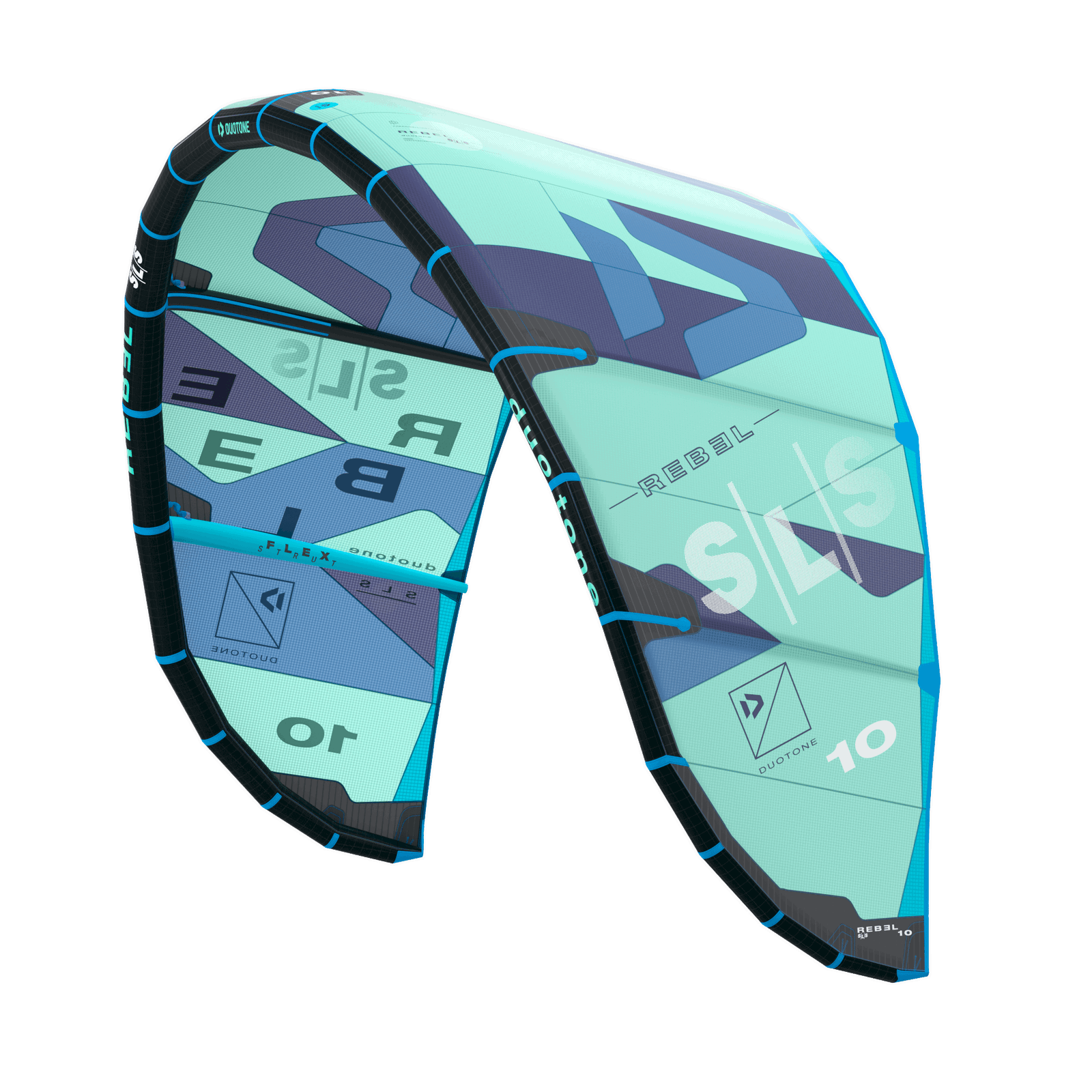
The first thing to notice about the Rebel: there is no base version at all. Only the SLS at
2 009 € and the D/LAB at 2 899 €. An unusual decision, and it explains a great deal.The short version
- Versions: SLS
Why there is no base version
The answer is in the stated purpose: high jumps and light wind. Both come down to one thing — weight.
We have covered the mechanics several times, but here they appear in pure form. A kite's lift first raises the kite itself, and only the remainder reaches you.
In light wind you sit exactly at the boundary where the kite stays airborne. Three hundred extra grams and it does not fly.
In a jump weight works twice: a lighter kite lifts higher and holds longer at the top.
Hence: a Rebel in a heavy construction would not do its own job. A base version would be a kite that fails at the thing the model exists for. The brand honestly did not build one.
How jumping coexists with light wind
An odd pairing at first glance: big air is usually about strong wind.
But the link is real, and it is area. Lift depends on wing area — we repeat that in every big-air review and remind readers that jumping wants a size up from freeride.
A big kite means plenty of lift, which means height. A big kite also works in light wind. It is the same quality applied to two different jobs.
The cost is also shared: a big kite turns more slowly and reaches its upper wind limit sooner. On why larger sizes have narrower ranges, see our Bandit review, where it is visible in the manufacturer's own table.
Rebel against Evo D/LAB
Both are stated for high jumps, and the difference is the main question within the range.
Evo D/LAB —
2 549 €. Purpose: freeride and high jumps. An all-rounder pushed into jumping territory by construction.Rebel SLS —
2 009 €. Purpose: high jumps and light wind. A specialised model.Note that the Rebel SLS is
540 € cheaper than the Evo D/LAB while both are about jumping. The gap is in construction tier rather than in model class.The practical conclusion: if jumping is your priority, the Rebel SLS gives you a specialised model for less than an all-rounder in the top construction.
Rebel against the North Orbit
A comparison with an outside rival, because the Orbit is the category benchmark.
North Orbit 2026 — from
1 729 €, sizes 5 to 15 m², with four seasons in our catalogue from 750 €.Rebel SLS — from
2 009 €, premium constructions only.The Orbit offers a wider entry in both price and sizes. The Rebel offers a higher construction class from the outset.
On how the Orbit compares within its category, see our Ozone Edge comparison and Switchblade comparison.
Who it suits
Anyone jumping on a light-wind spot. A rare combination, and exactly what the Rebel is built for.
Heavy riders. Over 90 kg your lower wind limit shifts up, and a light big kite returns the knots you lost.
Anyone already jumping confidently. Construction differences reveal themselves through technique rather than replacing it.
Who it does not suit
A first kite. With no base version, entry starts at
2 009 € — and at that stage technique is your limit.Anyone riding storms. Lightweight constructions tolerate extremes less well, and the model already leans towards large sizes.
Wave riders. You want drift — that is the Evo SLS.
Anyone after a cheaper entry. Look at a previous-season Orbit or a base Evo.
On sizes
The Rebel is listed as "size to be confirmed": the range is verified against the brand's stock before payment.
For a light-wind model that matters especially — the size you want is probably from the upper part of the range, and availability is worth confirming in advance.
Common questions
Why is there no base Rebel?
Its purpose is jumping and light wind, and both come down to weight. A heavy construction would fail at the model's own job.
How do jumping and light wind go together?
Through area: lift depends on it, and a large kite delivers both height and low-end performance.
Rebel SLS or Evo D/LAB?
The Rebel is
540 € cheaper and specialised for jumping. The Evo D/LAB is an all-rounder in the top construction.Is the Rebel suitable for a beginner?
No. Entry starts at
2 009 €, and while learning the construction difference will not show.What is a cheaper alternative?
A previous-season North Orbit: from
750 € with the same stated purpose.Where to buy
Duotone Rebel SLS from
2 009 € and the Rebel D/LAB from 2 899 €. The brand is in our Duotone review.Want advice from an instructor?
Our IKO instructors will help you choose gear or plan a kite trip to Mui Ne — free of charge.
Read next
The Pivot exists as base, Q Series, LTD, NVision and LW. How they differ in stated purpose and price, and whic…
Naish Pivot vs Ozone Reo: Two Views of a Wave KiteThe Pivot is stated as freeride plus waves, the Reo as pure wave. How an all-rounder with a wave bias differs …
Naish Boxer Review: From 2.8 to 16 Metres in One RangeThe Boxer covers a span most brands split across three models. Why a 2.8 m exists, what a 16 m does, and how t…