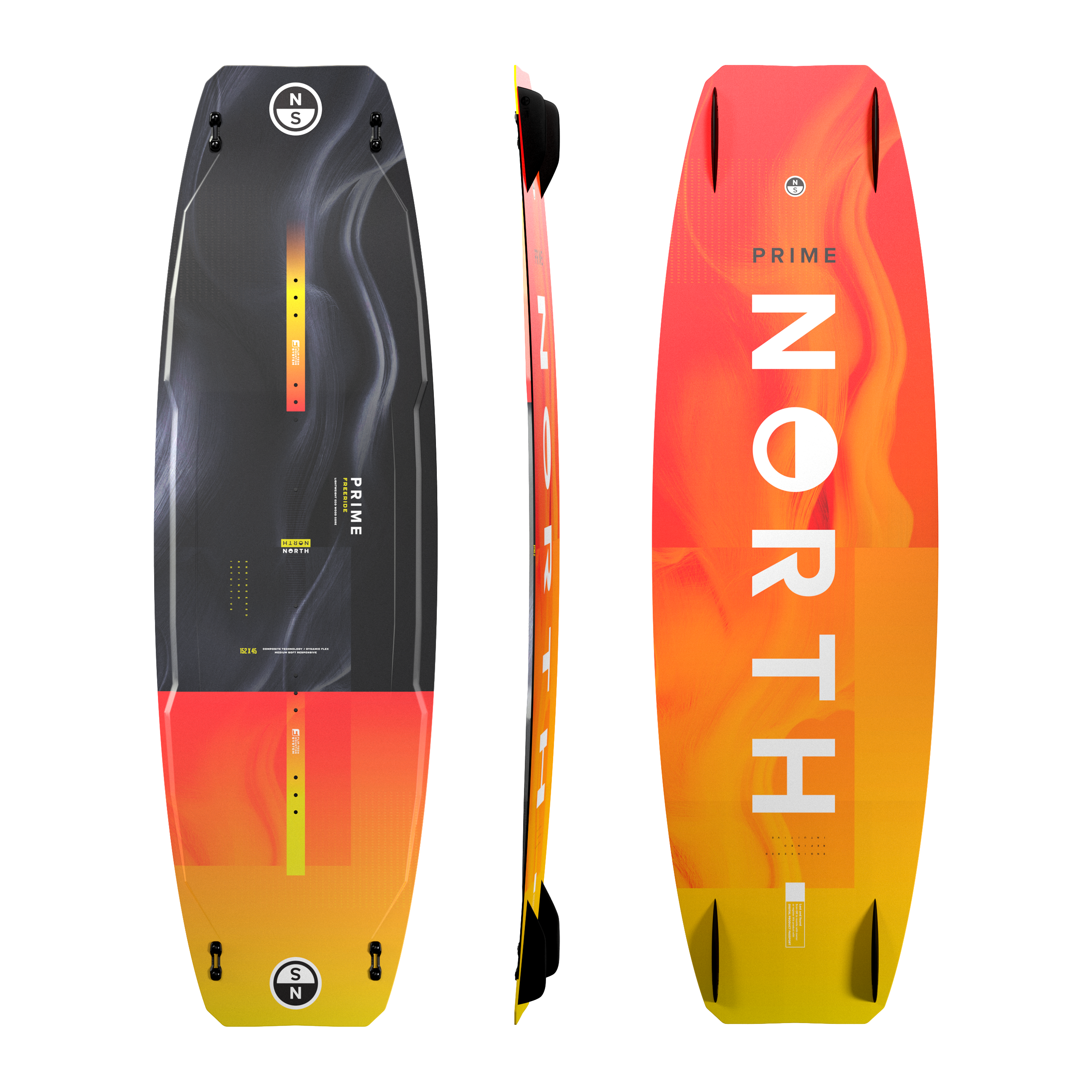
The Prime is the entry point into North's boards and simultaneously the range's most unusual position. The reason is its size ladder: six sizes from 136 to 152 cm, where the other models offer four and stop at 144.
The short version
- Model: Prime TT Board, 2026 season.
- Sizes: 136×40, 138×41, 141×42, 144×43, 148×44, 152×45 cm.
- Colour: Black / Orange Flash.
- Price:
152 centimetres: light wind without a dedicated board
The defining feature, and worth unpacking.
Brands normally build a separate model for light wind — like the CrazyFly Cruiser LW at 154 and 160 cm for
461 €. North instead simply extended its most affordable board to 152 cm.Why a big board works. To get going you must start planing. While the board ploughs water, drag is enormous; once it planes, drag collapses. Area decides at what speed that transition happens.
152×45 against a standard 138×41 is roughly a quarter more area. A kite that will not pull you on a 138 already carries you on a 152.
And the practical conclusion: a
619 € board extends your lower wind limit about as much as a larger kite at 1 500 € and up. If you are wondering what to buy second, buy the board.Softness is a function, not a saving
A point we repeat in every budget board review, because it is constantly read backwards.
The Prime is softer than the Atmos, and that is not "worse". A soft board absorbs chop, forgives crooked landings and does not throw you off your stance on a sloppy approach.
For someone learning, that directly determines how many hours they ride in a day. A stiff carbon board passes every mistake into your knees, and early on there are plenty of mistakes.
The threshold for stiffness is simple: you jump consistently and can feel the board failing to give back under edge load. Before that, carbon is paying extra for a quality that works against you.
Six sizes, one price
As with the Atmos, every size costs the same. Same logic: size follows weight and wind rather than budget.
- 136×40 — under 70 kg, windy spot.
- 138×41 — 70 to 80 kg, the all-rounder.
- 141×42 — 80 to 90 kg.
- 144×43 — over 90 kg or moderate-to-light wind.
- 148×44 — heavy riders, light wind.
- 152×45 — light wind, a second board for the quiver.
Width grows with length as on the Atmos — all sizes behave identically and differ only in area.
Who it suits
A first personal board after lessons. The main and most honest scenario.
Heavy riders. 148 and 152 cm exist in no other North line.
Anyone on a light-wind spot. Half the sessions lost in a year are lost not to no wind but to two knots short.
As a second board. 152 cm at
619 € is a cheap way to widen your range.Rental fleets. Soft, forgiving, one price across six sizes.
Who it does not suit
Anyone jumping seriously. You want pop — that is the Atmos or Focus Hybrid.
Freestylers. A soft board returns less under load.
Anyone already feeling limited by the board. You have outgrown the Prime, and that is fine.
Previous seasons — especially good value here
The Prime lives in the catalogue across four years, with a substantial spread: 2020 at
275 €, 2024 at 347 €, 2025 at 449 €, 2026 at 619 €.With boards the season gap is smaller than with kites: shape and flex last for years, while graphics and finish change. For a learning board, last season is almost always the right call — not least because first boards get knocked about.
On choosing a model year, see our separate article.
Common questions
Is the Prime suitable for a beginner?
Yes, that is its stated purpose: soft, forgiving, with a wide size range.
What does the 152 cm give you?
It widens your lower wind limit about as much as a larger kite, at a third of the price.
How does the Prime differ from the Atmos?
Softer,
180 € cheaper, and it runs to 152 cm against the Atmos's 144.Which size at 85 kg?
141×42 for average wind, 144×43 if the wind is often light.
Is a previous-season Prime worth buying?
Yes. Year-to-year changes in boards are minimal, and the price difference reaches twofold.
Where to buy
619 €, six sizes. Previous seasons: 2025 and 2024. The full range is in our North boards overview.Want advice from an instructor?
Our IKO instructors will help you choose gear or plan a kite trip to Mui Ne — free of charge.
Read next
The Pivot exists as base, Q Series, LTD, NVision and LW. How they differ in stated purpose and price, and whic…
Naish Pivot vs Ozone Reo: Two Views of a Wave KiteThe Pivot is stated as freeride plus waves, the Reo as pure wave. How an all-rounder with a wave bias differs …
Naish Boxer Review: From 2.8 to 16 Metres in One RangeThe Boxer covers a span most brands split across three models. Why a 2.8 m exists, what a 16 m does, and how t…