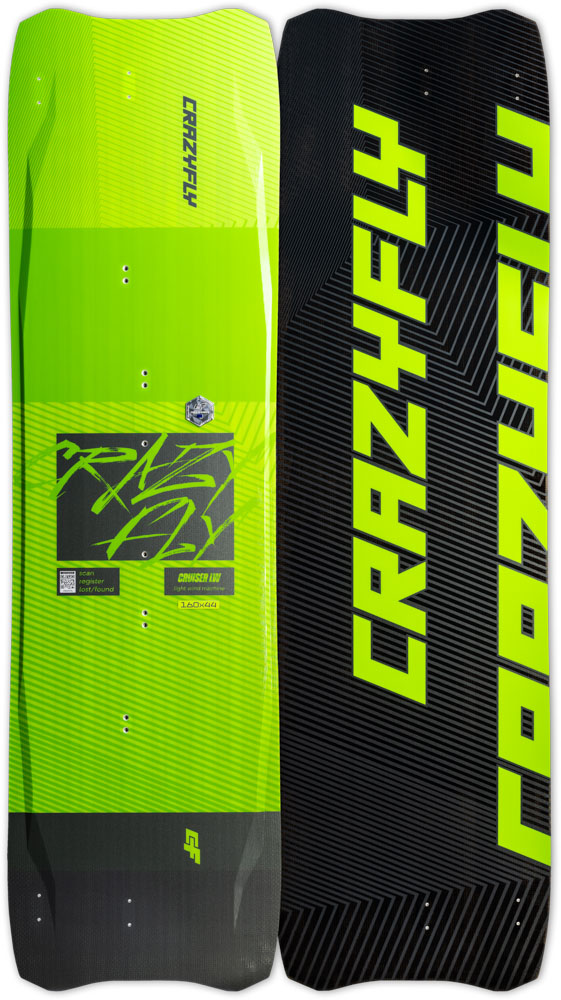
There are two ways to solve light wind: a big kite or a big board. A kite starts at
1 500 €, a board costs 461 €. A threefold price difference for a comparable gain at the bottom of the range. Here is how that works.The short version
- Sizes: 154 × 44 and 160 × 44 cm.
- Weight: 3.5 to 3.7 kg.
- Construction: multiaxial fibreglass.
- Discipline: light wind.
- Season: 2026.
- Price:
Why a big board works
To get going you have to start planing. Until the board planes it ploughs water and drag is enormous. Once it planes, drag drops sharply and riding takes care of itself.
Board area determines at what speed that transition happens. More area, earlier transition, less power needed from the kite.
Hence the numbers: 160 × 44 against a typical 140 × 42 is roughly a third more area. The transition comes noticeably earlier, and a kite that will not pull you on a 140 already carries you on a Cruiser.
Why fibreglass rather than carbon
The most interesting decision in this board, and a counterintuitive one: CrazyFly's senior boards are carbon, and the light-wind board is fibreglass.
The reason is the job. Carbon exists to deliver stiffness at low weight. Stiffness delivers pop — and a light-wind board is not about pop: in twelve knots you are not jumping, you are trying to keep moving.
What you actually need is area, softness and a sensible price. A softer board rides small ripple better, and small ripple is the entire surface in light wind. Carbon at 160 cm would add
300 € and a stiffness that gets in the way here.The 3.5 to 3.7 kg follows from the same logic: normal for that area in fibreglass, and on the water board weight barely registers because the water carries it.
Two sizes: which one
The difference is length only — width is 44 cm on both.
154 × 44 — for riders up to roughly 85 kg, or if you want a board you can also use in moderate wind.
160 × 44 — for heavy riders and for anyone buying strictly for calm days. In moderate wind it will be too much board.
Honestly: a light-wind board is a specialised tool. Do not try to make it your everything board — in twenty knots it becomes unmanageable.
Board or kite: what to buy first
A practical calculation that rarely gets spelled out.
A second, larger kite costs from
1 500 €, takes luggage space and may need a second bar if the size gap is large.A light-wind board costs
461 €, travels in the same bag and needs nothing else.Their effect on your lower wind limit is comparable. So the board is the logical first purchase, with a big kite later if that turns out not to be enough.
The exception: if you foil, the priorities invert — board area does not decide things there, and a big light kite like the Zephyr works better.
Who it suits
Anyone whose spot often gives 12 to 15 knots. The main scenario.
Heavy riders. Over 90 kg your lower limit shifts up, and area gives back the knots you lost.
Anyone tired of sitting on the beach. Half the sessions lost in a year are lost not to no wind but to two knots short of enough.
Who it does not suit
As a only board. In strong wind it gets thrown by chop and holds an edge poorly.
Jumpers. Soft fibreglass and large area are about going, not flying.
Foilers. An entirely different story.
Common questions
From what wind does a light-wind board work?
It does not create wind; it lowers the threshold. A realistic gain is a couple of knots, and on light spots that is half your sessions.
Can I ride it in twenty knots?
Technically yes, comfortably no. It will feel nervous and harsh in chop.
Which size at 75 kg?
154 × 44. The 160 is for heavier riders or for a board bought strictly for calm days.
Do I need a special kite for it?
No, and that is the point: the board extends the range of the quiver you already own.
Why isn't it carbon?
Because a light-wind board does not need stiffness and the price would rise noticeably. A deliberate decision rather than a saving.
Where to buy
461 €, two sizes. The rest of the range is in our range overview, and sizing in the basics.CrazyFly Cruiser LW 2026 Kiteboard at K1.surf
Official CrazyFly dealer. From 527 €. Our IKO instructors match the size to your weight, level and wind.
Read next
The Harlem PEAK at 2,144, the Thrive LiteX at 2,794, the Ozone Edge Ultra-X at 2,819. What really sits behind …
Wake and Tow Foiling: Behind a Boat, With No Wind and No WavesWKT boards are built for towing behind a boat or a cable park. How it works, why the boards are so small, and …
Slingshot Brand Review: The Americans Who Built a Kite Without StrutsSlingshot is known for durability and unusual constructions — from the Code to the single-strut UFO. Seven cat…