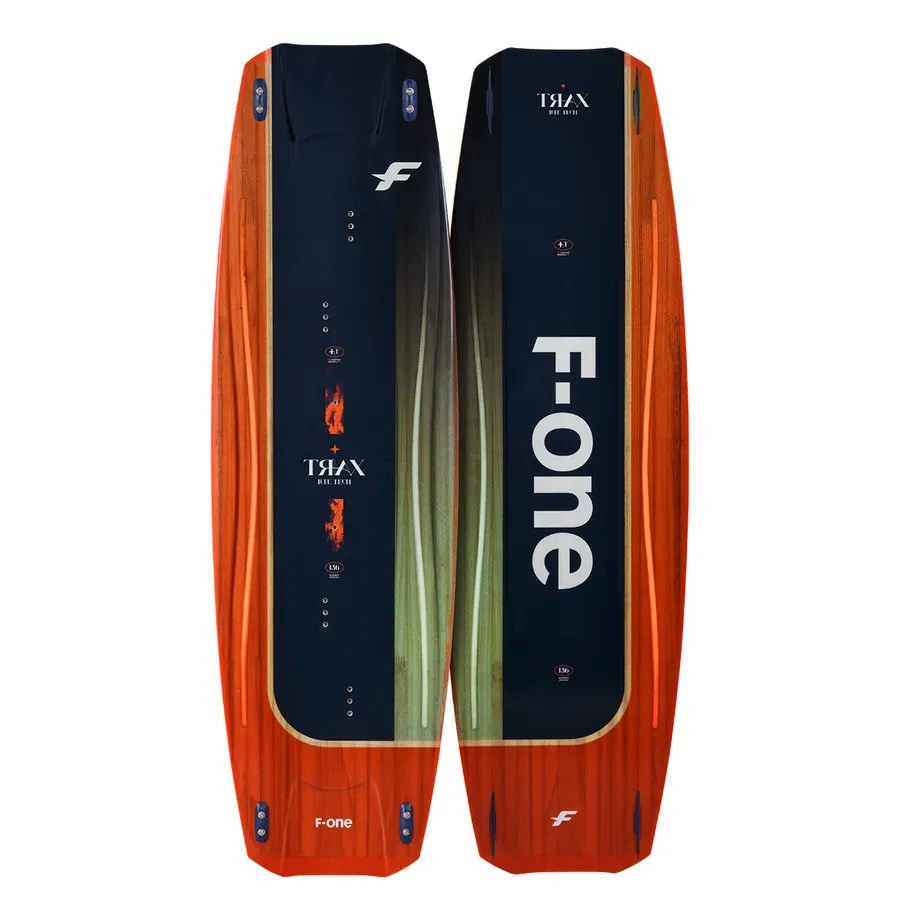
The Trax has been in F-One's line longer than anything else. The Lite Tech version is a lightweight build at
560 € for any size.The short version
- Sizes: 135×39, 136×40.5, 137×42, 139×42, 140×45 cm.
- Weight: 2.9 to 3.1 kg.
- Disciplines: freeride and freestyle.
- Price:
Width grows faster than length — which is unusual
Look at the range carefully. From 135×39 to 140×45: length grew by 5 cm, width by 6.
Usually it is the other way round. At most brands width adds a centimetre for every two or three of length — we saw that in the North Atmos review, where the range runs 136×40, 138×41, 141×42, 144×43.
What faster width growth delivers:
More area at less length. A 140×45 board has area comparable to a 148 cm board of standard width while staying short and manoeuvrable.
Early planing without losing handling. A long narrow board turns worse; a short wide one does not.
The practical conclusion: when choosing between Trax sizes, weigh width more heavily than usual. Five centimetres of width between the extremes is a lot.
135×39: the narrowest size and who it is for
Thirty-nine centimetres is narrow even for a short board.
A narrow board transitions edge to edge faster and grips the water less under load. That is a freestyle quality: in a trick with slack the board must release the water instantly.
The trade-off is later planing and less area. A size for light riders and windy spots rather than for general riding.
140×45: almost light wind
The other extreme. Forty-five centimetres of width at 140 cm length is a very wide board.
It planes earlier and keeps you going in light wind while staying short. Effectively a light-wind size that never became a light-wind board.
Compare North's Prime logic, where light wind was addressed by extending the range to 152 cm. F-One adds width instead of length — and to our mind that is the smarter answer: the board stays controllable.
Weight: 2.9 to 3.1 kg
Normal for a lightweight build at 135 to 140 cm. For comparison, the CrazyFly Raptor weighs 2.8 to 3.0 kg.
A reminder of what board weight buys: a lighter board rotates faster in the air and pulls less on your legs. In ordinary freeride the difference barely registers.
We said it in the CrazyFly range review and will repeat it: if you do not spin, board weight is the last thing worth paying extra for.
One price across five sizes
560 € for any size — the same logic as at CrazyFly and North: size gets chosen by weight and wind rather than by budget.When sizes are priced differently, people are tempted by the cheaper one and end up on the wrong board.
Which size to buy
- 135×39 — under 70 kg, windy spot, freestyle bias.
- 136×40.5 — 70 to 78 kg.
- 137×42 — 78 to 85 kg, the most universal.
- 139×42 — 85 to 92 kg.
- 140×45 — over 92 kg or regularly light wind.
The general logic is in our twintip guide.
Who it suits
Freeriders trying freestyle. Both disciplines are stated.
Anyone who values manoeuvrability. The narrow Trax sizes switch edges faster.
Anyone on a light-wind spot. The 140×45 covers that without a separate board.
Who it does not suit
Complete beginners. A lightweight build is stiffer, and starting out wants softness.
Anyone spinning seriously. Look at the Trax HRD Carbon.
Wave riders. You want a directional — at F-One that is the Mitu Pro or Keahi Pro.
Common questions
Which Trax size at 80 kg?
137×42 cm. On a light-wind spot, 139×42.
How does Lite Tech differ from Carbon?
Construction and stiffness. Carbon is stiffer and lighter; Lite Tech is a sensible balance at
560 €.Why does width grow faster than length?
Width adds area without costing manoeuvrability. A long narrow board turns worse.
Is the Trax suitable for learning?
As a first board after lessons, yes. For lessons themselves, go softer.
Does it come with bindings?
F-One twintips ship with bindings and pads. People add a bag and spare fins.
Where to buy
560 €, five sizes. The other boards are on the F-One page and in the twintip section.F-One TRAX Kiteboard at K1.surf
Official F-One dealer. Our IKO instructors match the size to your weight, level and wind.
Read next
AXIS offers a four-component configurator rather than a finished foil. How to choose in the right order, which…
Foil Etiquette: Why Foilers Are Unpopular and How to Fix ItA metal wing underwater is invisible, and that is the root of every conflict at a spot. The rules that formed …
Electric Assist for Foiling: A Motor You Run for Twenty SecondsFoil Drive and Assist put a compact motor on the mast to get you up to takeoff speed. How it works, what it co…