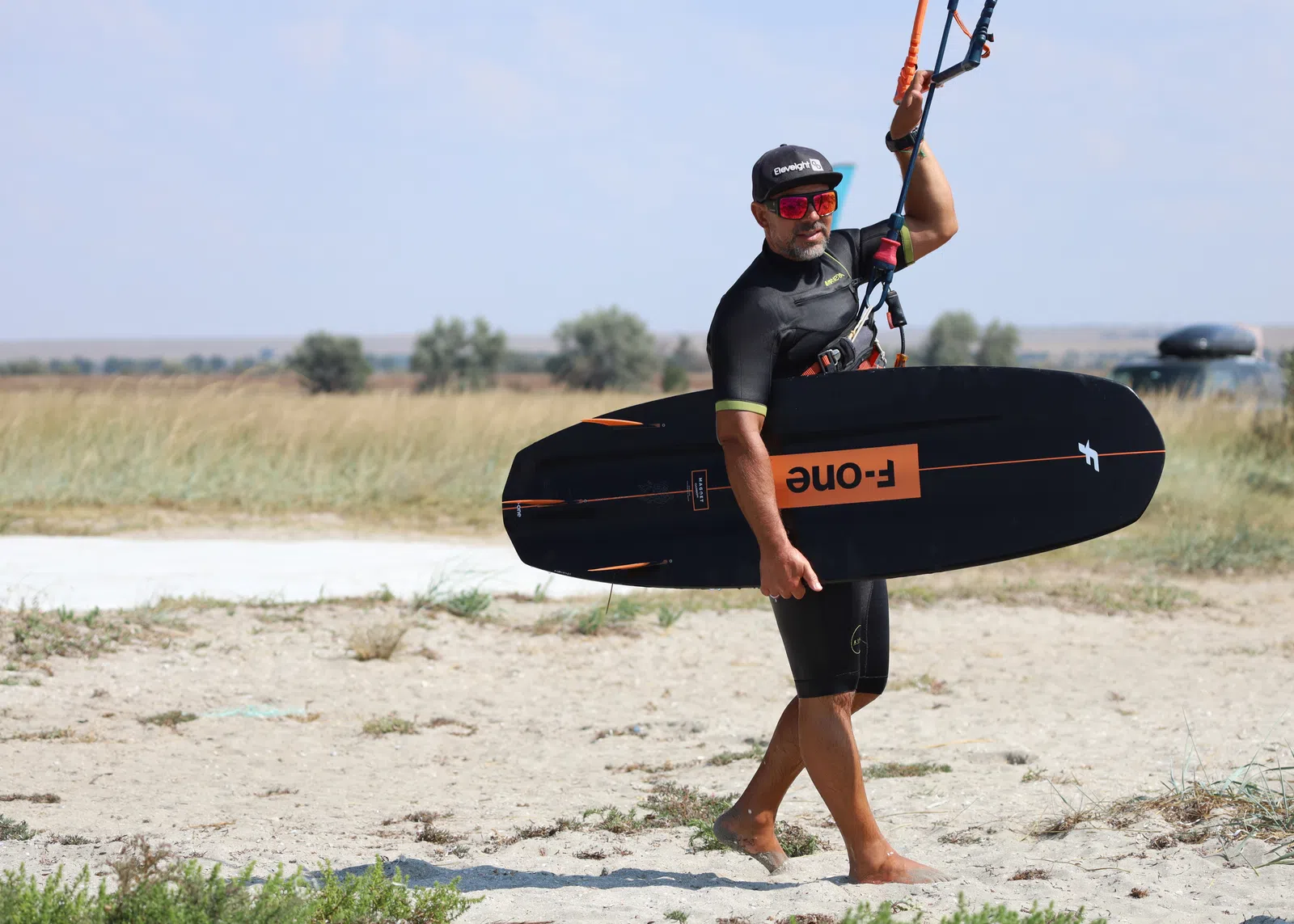
A foil generates a force at the mast that tries to tear it out of the board. Whether an inflatable can take that is a fair question, and the answer is more interesting than it looks.
What the range holds
- Air Foil Inflatable —
Hard boards for comparison: Pump Foilboard
699 €, Take Off 1 299 €, Ace Foil 2 199 €.How an inflatable holds a mast
The key engineering question, and it is not solved by the skin.
A rigid plate is bonded inside carrying the mast bolt inserts, and it spreads the load across an area rather than concentrating it at a point.
Why that works. Inflated to high pressure, the board behaves like a rigid body — pressurised air compresses poorly. The issue is not strength but micro-flex.
And here the real compromise begins. On a hard board the effort from your feet reaches the wing almost without loss. On an inflatable some of it disappears into barely perceptible hull flex — control becomes slightly mushier and response lags by fractions of a second.
In practice: a beginner will not notice at all. An experienced rider notices immediately.
What an inflatable gives in return
1. It does not cut
The most underrated argument, and it concerns safety.
Falling onto the foil is the discipline's main injury, and a hard board with sharp rails adds its own share.
An inflatable is soft across its whole surface. Falling onto it means a bruise rather than a gash. At the stage where you fall twenty times a session, that genuinely lowers risk.
2. Transport
A foil board is under a metre eighty, but still oversize for a plane. An inflatable travels in a bag as ordinary luggage.
Given that foiling is a discipline people travel to specific spots for, that counts.
3. Volume at the same length
An inflatable is thicker, so at equal length it carries more volume — more buoyancy at the start.
On why volume decides while learning, see our foil range guide.
Where an inflatable loses
Control precision. Hull micro-flex is a real physical effect.
Wind. A thick board catches wind: before takeoff it tries to get away from you.
The top level. Competition, pumping and aggressive turns — hard board, no alternatives.
Insert life. The bonded joint is the most loaded area and lasts less than inserts in a hard board.
Separately: the Pump Foilboard at 699 euros
The cheapest foil board in the range — and it is hard, not inflatable.
Pumping means moving on a foil without wind or waves, by rocking the board vertically with your body. The discipline demands minimal volume and maximum stiffness: any loss in the hull kills momentum.
So an inflatable does not work for pumping at all. A neat illustration of a job dictating a construction.
Choosing in under a minute
Learning and falling often → the inflatable Learner: soft and voluminous.
Flying with the board → inflatable, question closed.
Riding with children nearby → inflatable: it does not cut.
Second season, flying confidently → hard: you will feel the precision now.
Pumping → hard only, the Pump Foilboard.
Competition → hard.
One board for everything → a mid-priced hard board: more versatile.
Safety — briefly and non-negotiably
Helmet and vest. An inflatable lowers the risk from the board, not from the foil — the metal wing underwater stays sharp.
Fall sideways. The first thing to drill before flying.
Depth. A 70 to 90 cm mast will plant itself in shallows.
More in our seven steps to safe riding.
Common questions
Will an inflatable take foil loads?
Yes: a rigid plate with inserts is bonded inside, spreading the force across an area.
What is the main drawback?
Hull micro-flex: control is mushier and response lags. A beginner will not notice; an expert will.
Why is an inflatable safer?
It is soft: falling onto it bruises rather than cuts. It does not protect you from the foil itself.
Can I pump on an inflatable?
No. Pumping needs maximum stiffness — hull losses kill momentum.
What should a first foil board be?
An inflatable learner if you fall often and travel with it. A hard board if your spot is close and you plan to progress fast.
Where to buy
899 €, Air Foil Learner 1 339 €, Pump Foilboard 699 €. The section: foil boards.Want advice from an instructor?
Our IKO instructors will help you choose gear or plan a kite trip to Mui Ne — free of charge.
Read next
Getting from the airport to Mui Ne: a private transfer for €60 (4 seats) or €70 (7 seats), how long it takes, …
GONG SUP from 99 Euros: What Sits Behind That PriceThe cheapest SUP in our catalogue costs 99 euros, the cheapest adult one 199. Where that price comes from, wha…
GONG I-SUP: Nine Models for Nine JobsAllround, Cruising, Race, Family, Explorer, Adventure, Hybrid, Longboard, Shortboard — a range split by purpos…