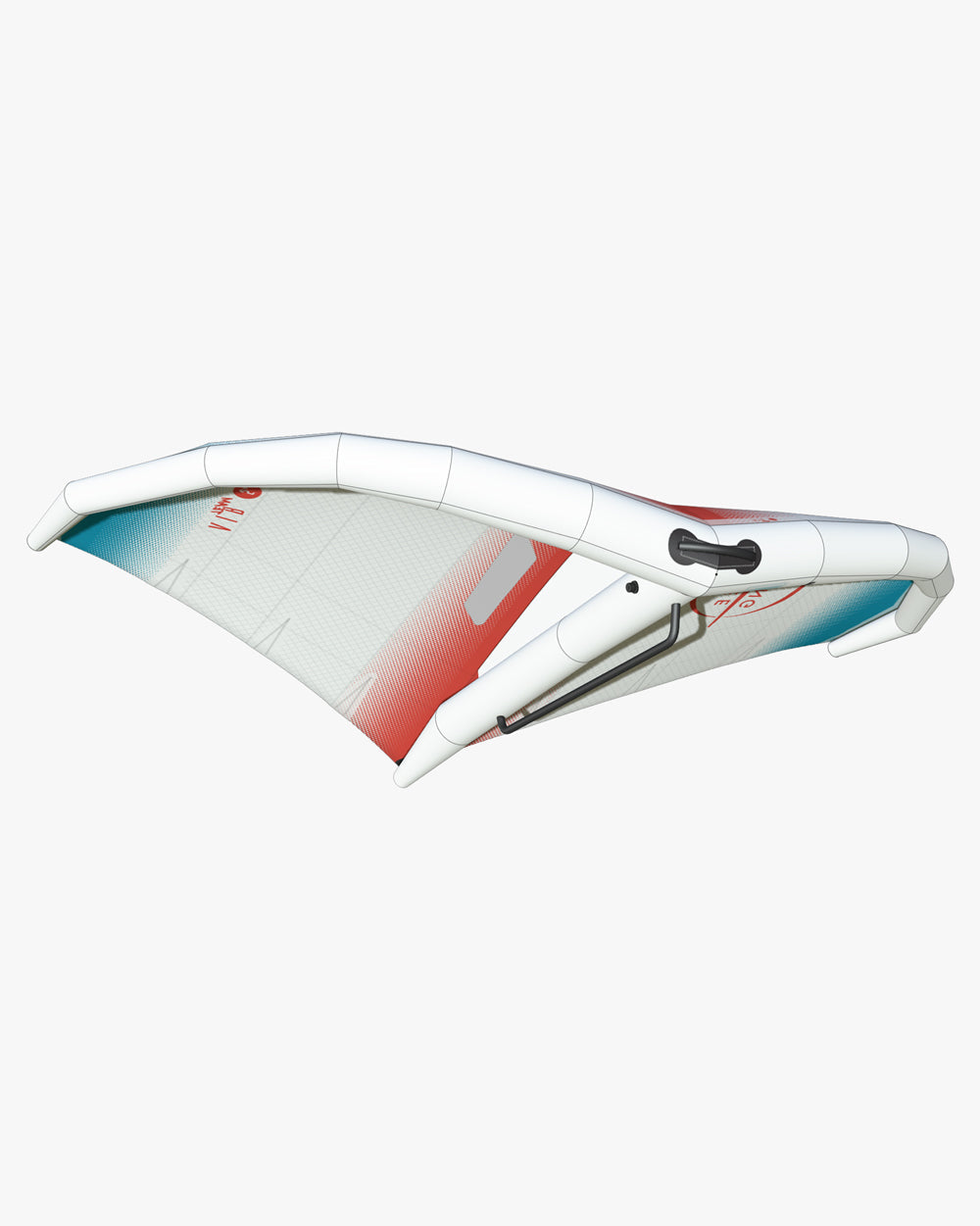
Starboard offers five wing models across a threefold price range. Here is what sits behind each — the range is laid out more logically than most.
Five models by price
- FreeWing LIFE —
The key point: the size ladder reveals the job
Note a difference that is easy to miss.
The LIFE has five sizes in one-metre steps: 2.5, 3.5, 4.5, 5.5, 6.5.
The AIR v5 has twelve in half-metre steps, from 2.5 to 8.0.
What that means. A coarse step signals a model for people running one or two wings for everything. A fine step is for riders matching size to wind precisely across a quiver of three or four.
The practical upshot: buying a first wing, the LIFE's coarse ladder will not hurt you. If you already ride and know a 4.5 is small and a 5.5 is big, you want half-metre steps.
An eight-metre wing — why
The AIR v5 tops out at 8.0 m², which is unusual.
Big wings mean light wind. The same logic as kites: more area, less wind needed.
But winging has a constraint kiting does not: you hold the wing in your hands. An eight-metre wing is physically heavy, and you feel it after half an hour.
So such sizes are bought for access rather than comfort: either the 8.0, or you do not ride today.
The honest alternative: a larger foil area achieves a similar effect more cheaply and without loading your arms. We covered this in our kite foil versus wing foil comparison.
Choosing a first size
The rule is simple and it works.
One wing to start: 5.0 m² at 70 to 85 kg. It covers the mid-range wind you will learn in.
Under 65 kg: 4.5 m².
Over 90 kg: 5.5 to 6.0 m².
A second wing should be two to two and a half metres smaller, not half a metre. Half a metre is barely perceptible on the water and you will simply have bought the same wing twice.
A typical two-wing quiver: 4.0 and 6.0. Three: 3.5, 5.0, 6.5.
What Team and PRO mean
The same story as kite suffixes, covered in our suffix guide.
The AIR v5 is
1 129 €, the AIR Team v5 1 939 €. A gap of 810 € under the same model name.What you pay for: materials, weight, frame stiffness.
Why weight matters more in winging than in kiting: you hold that weight in your hands for the whole session rather than through a harness. Three hundred grams on a wing are felt more than three hundred grams on a kite.
Even so: a first wing should not be the lightweight version. At the stage where you fall every two minutes, wing weight is not your limit.
Separately: the Pistol Grip Wing Boom
The range includes a hard boom at
75 € — a part rather than a wing.Boom versus handles is its own question, covered in our dedicated article. In short: a boom gives free hand placement, handles give less weight and a lower price.
Choosing in under a minute
First wing → FreeWing LIFE 5.0 or Source: entry at
769 €, stated purpose exactly progression after lessons.Second season, needing exact sizes → AIR v5: twelve options in half-metre steps.
Freestyle → AIR v5, first word of its stated purpose.
Light wind → AIR v5 at 7.0 to 8.0, but consider a larger foil first.
A hundred days a season → Team or PRO: wing weight will become your limit.
On a budget → LIFE: nearly a threefold gap to the top, and you can learn on any of them.
Common questions
What size wing should I buy first?
5.0 m² at 70 to 85 kg. Under 65 kg, 4.5; over 90 kg, 5.5 to 6.0.
Why does the AIR v5 have twelve sizes and the LIFE five?
Half-metre steps serve riders with three or four wings. For one or two wings a coarse ladder is fine.
Why an 8-metre wing?
For light wind. But it is physically heavy, since you hold it in your hands. Often a larger foil is cheaper.
Should a first wing be a Team or PRO?
No. While you fall every two minutes, wing weight is not your limit.
How much smaller should a second wing be?
Two to two and a half metres. Half a metre is barely noticeable on the water.
Where to buy
769 €, Source 799 €, FreeWing AIR v5 1 129 €. The whole section: wings.Starboard at K1.surf
Genuine Starboard gear. Our IKO instructors match the size to your weight, level and wind.
Read next
The Harlem PEAK at 2,144, the Thrive LiteX at 2,794, the Ozone Edge Ultra-X at 2,819. What really sits behind …
Wake and Tow Foiling: Behind a Boat, With No Wind and No WavesWKT boards are built for towing behind a boat or a cable park. How it works, why the boards are so small, and …
Slingshot Brand Review: The Americans Who Built a Kite Without StrutsSlingshot is known for durability and unusual constructions — from the Code to the single-strut UFO. Seven cat…