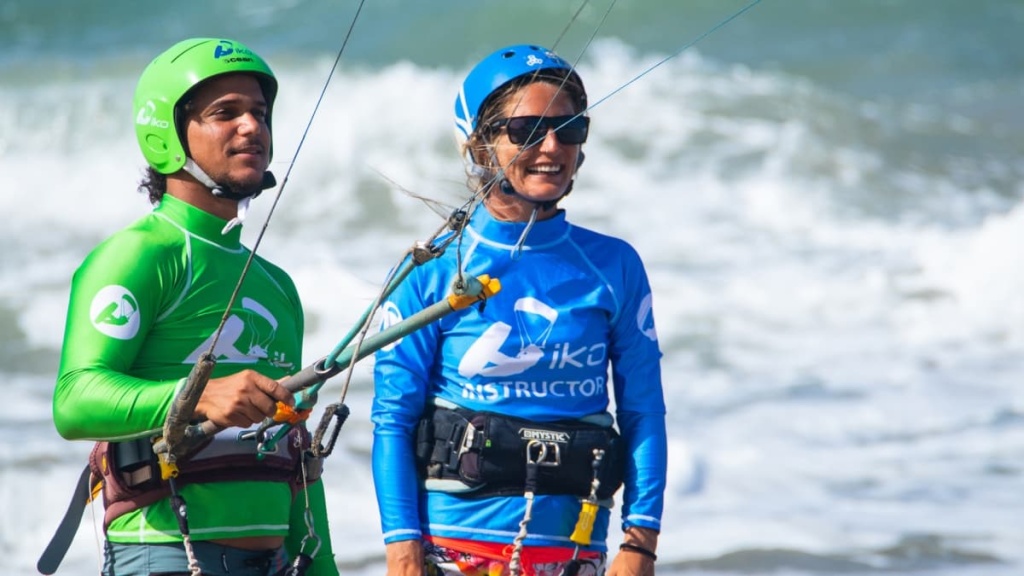
This is the practical version: what actually happens between deciding to learn kitesurfing and riding away on your own board. Not the marketing arc — the real sequence, the hours it takes, the parts everyone finds hard, and the mistakes that cost people a week.
The short answer
8 to 15 hours with an instructor, spread over four to seven days, at a spot with shallow water and side-shore wind. Roughly four hours to fly the kite properly, eight to get on the board, twelve to fifteen to ride upwind and come back to where you started.
Everything below is the detail behind those numbers.
Step 1. Theory and the wind window (about 1 hour)
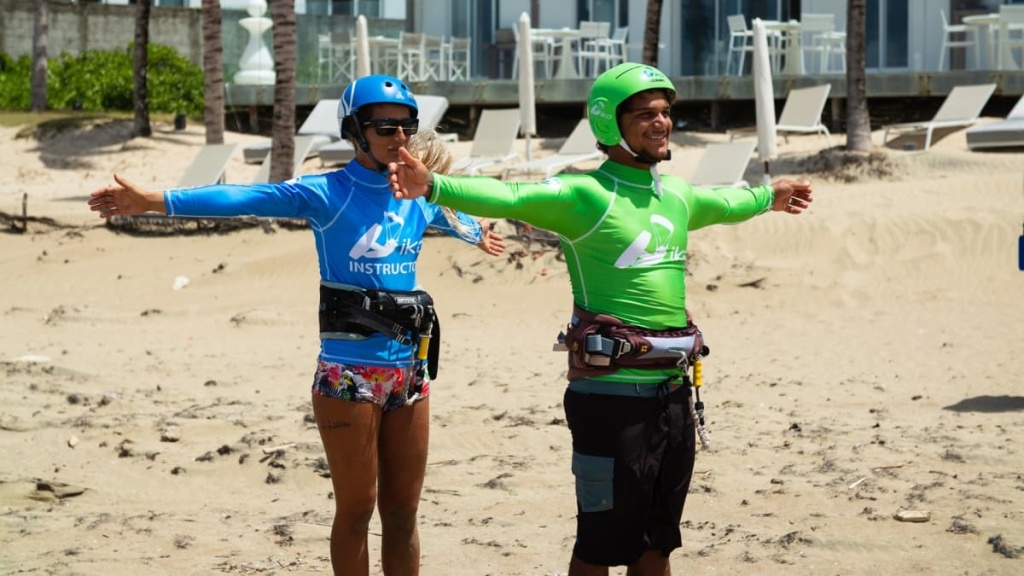
On the sand, before anything inflates. You learn how wind direction relative to the beach defines what is possible: side-shore is ideal, onshore is workable, offshore means nobody rides today. You learn to spot hazards upwind and downwind, and to read the surface for gusts.
Then the wind window — the arc of sky the kite flies in, with a power zone in the middle and quiet edges. Riders describe kite position on a clock face, and by the end of this hour you should too.
Finally the safety systems: the quick release, the leash release, and where they are on your harness. You will practise pulling them until you can do it without looking, because on the water you will not be looking.
Step 2. Flying the kite (2–4 hours)
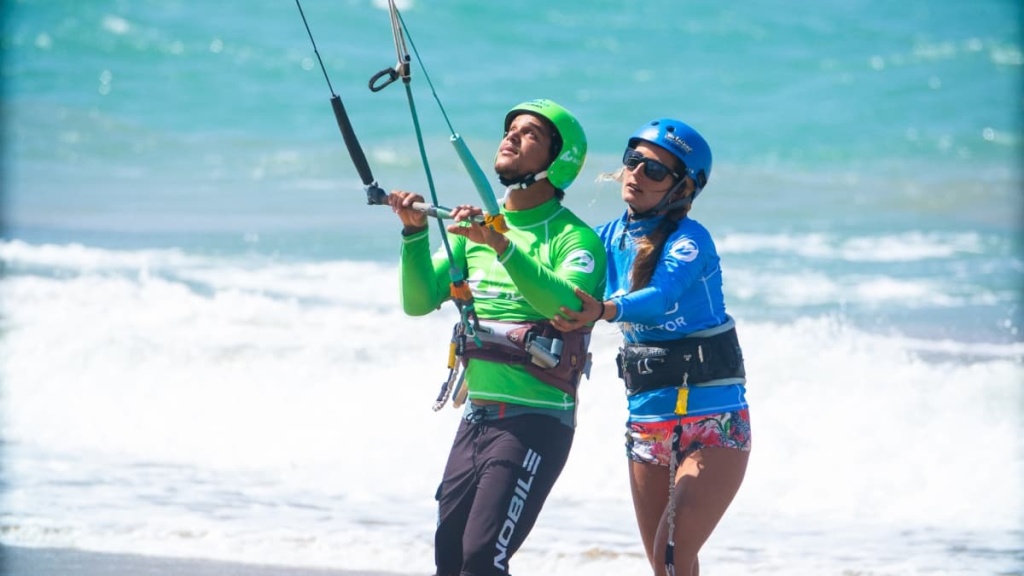
A trainer kite first, then the real one, on land and in shallow water. This is where most people spend more time than they expected, and where the difference between a good school and a bad one shows.
What you are actually learning:
- Parking the kite at the edge of the window and leaving it there while you think about something else.
- Moving it deliberately through the window to make power, and taking the power away on purpose.
- Depowering — pushing the bar away as an instinct rather than a decision. Every beginner's instinct is to pull the bar in when frightened, which does exactly the wrong thing. Unlearning that is the point of these hours.
- Relaunching the kite from the water.
If you are impatient here, be aware that everything later is built on it. Riders who rush this stage spend the rest of the course fighting the kite instead of steering it.
Step 3. Body dragging (2–3 hours)
You go into the water without a board and let the kite pull you. Downwind first, then across the wind, then upwind, then one-handed while your other hand reaches out as if recovering a board.
This is the step that makes you self-sufficient, and the one beginners most want to skip. The reason it matters: on your first real riding days you will lose the board constantly, and a board you cannot retrieve is a board that has left. Upwind body dragging is how you get it back.
Step 4. Self-rescue (about 1 hour)
Packing the kite down on the water, winding the lines around the bar, and either sailing the kite in as a makeshift sail or swimming home with it on your chest. Plus the distress signal — one arm raised and waved slowly.
Everyone finds this boring until the day the wind dies half a kilometre out. Then it becomes the most valuable hour of the course.
Step 5. The water start (2–4 hours)
The part everyone came for. Board on your feet, kite dropped down into the power zone and driven back up, and the pull stands you up.
The first attempts are short and undignified for everybody. The three things that go wrong, in order of frequency:
- Standing up too early, before the kite has generated pull. The board stops, you go over the front.
- Too much power, from sending the kite too hard through the window. You get yanked forward.
- Looking at the kite instead of where you are going. Where you look is where you steer.
Then something clicks, usually within a session or two, and it stops being a series of attempts and starts being a start.
Step 6. Riding upwind (3–5 hours)
This is the skill that turns a beginner into a rider, and it is the one nobody photographs. Riding upwind means finishing the session where you began instead of a kilometre downwind with a long walk back.
It is about edging: putting the board on its edge and letting it resist the pull rather than sliding sideways. Weight back, front leg extended, kite parked lower than feels natural. Most people fight this for a few sessions and then it arrives all at once.
Once you can ride upwind, control your speed and turn, you are done with the course and ready to rent equipment anywhere in the world.
What decides how fast you learn
Not age, not fitness, not weight. In our experience the three things that actually matter:
Water time. The wind decides. Ten days with steady wind beats a fortnight of waiting. This is why the destination matters as much as the school.
Patience with kite control. The students who progress fastest are the ones who did the boring drills without complaining.
Reaction to going wrong. Everyone gets dragged, tangled or overpowered at some point. Those who stay calm progress; those who panic repeat the same lesson.
Mistakes that cost people a week
- Learning at a bad spot. Deep water, gusty wind off buildings or hills, no room downwind. Conditions can double the hours required.
- Booking too few days. A five-day trip with two windless days becomes one lesson and a holiday.
- Taking too big a kite. Overpowered riding teaches fear. Smaller is faster in the long run.
- Buying equipment first. You do not yet know what you ride, and beginner-appropriate is not what you will want in a year.
- Group lessons with four students. You get a quarter of the water time and pay for the view.
- Self-teaching from videos. The videos are fine. What they cannot do is watch the beach while you watch the kite.
What to bring
A rash guard with long sleeves — you will be in the sun for hours and reflected light burns worse than you expect. Sunglasses with a leash, sunscreen, water. In warm destinations you need no wetsuit at all: in Mui Ne the water sits at 25–28 °C year-round.
Everything else — kite, bar, board, harness, helmet, impact vest — comes from the school. Do not buy before you finish.
Frequently asked questions
Can I learn in a week?
Usually yes, if the wind cooperates. Ten days is safer, two weeks means you leave riding rather than leave nearly riding.
Is it better to learn one-to-one or in a pair?
One-to-one is fastest. Two students to one instructor is a reasonable compromise for people at a similar level and costs less each. Four is a queue.
How much does a full course cost?
With us,
600 € for the full 15 hours from zero to independent riding, including gear, radio helmet and insurance. A single trial hour is 55 € and is credited if you continue.What if I already tried once and it did not work?
Extremely common, and usually a spot or ratio problem rather than a you problem. Tell your new instructor exactly where you stopped and they will start there instead of at the beginning.
When can I rent equipment on my own?
When you can launch, land, ride upwind and self-rescue — Level 3 in the IKO system. Most stations ask for proof, which is why the card at the end of a course is worth having.
Where to do it
Choose shallow water, a sandy bottom, side-shore wind and many windy days in a row. Our school in Mui Ne has all four from November to April — courses, levels and prices are on the kitesurfing lessons page, and the honest description of the destination is in the Mui Ne guide.
Want advice from an instructor?
Our IKO instructors will help you choose gear or plan a kite trip to Mui Ne — free of charge.
Read next
Three numbers — length, width and volume — decide whether you paddle or fall. What each one means and how to m…
Inflatable SUP vs Hard Board: What to Choose and the Real DifferenceAn inflatable fits in a boot; a hard board goes faster. Eight differences you feel on the water, and when payi…
Starboard Brand Review: SUP, Windsurfing and Foils — 200 ProductsStarboard came out of windsurfing and became the leading name in SUP. The range: inflatable and hard boards, p…