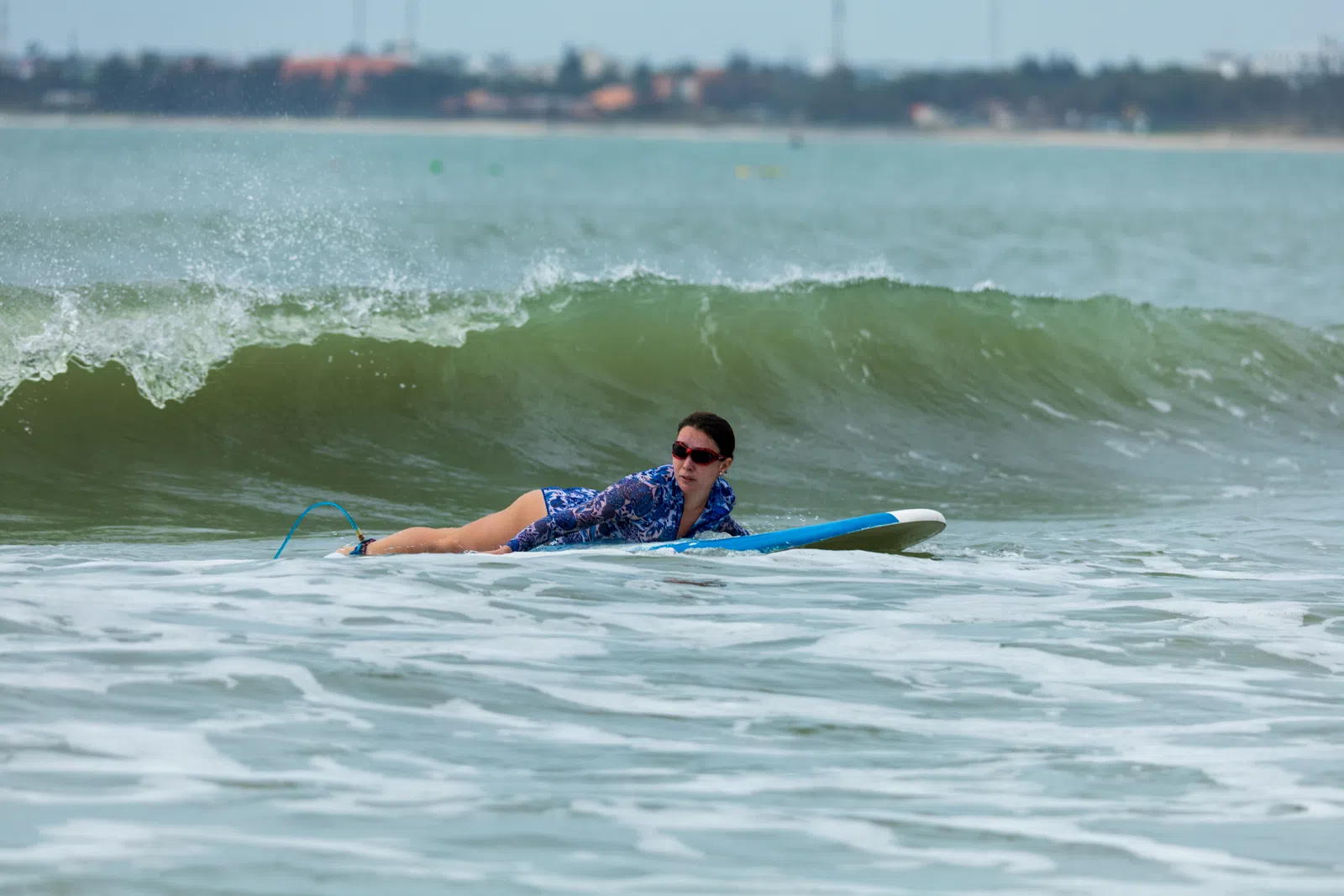
Prone foiling is surfing with a foil under the board. Here is what it offers a surfer and why it is the one discipline where a single wave lasts minutes.
The point of it
Ordinary surfing ends where the wave ends. It closes out and you paddle back.
On a foil the wave does not end. The wing keeps carrying you after the wave has stopped being a wave: you ride off it onto open water, sustain speed by pumping, and head for the next one.
What that changes in practice:
- One wave lasts a minute or more instead of ten seconds.
- Waves useless for surfing become rideable — small, gentle, crumbling ones.
- Fewer people. You ride where a surfer has no reason to be.
Which is why prone grows fastest in weak-wave places. It turns a dull spot into a working one.
Which board it needs
Simpler requirements than downwind, but specific.
Short. The AXIS Prone 26 is 4'1" — 124 cm. For comparison, an ordinary surfboard starts at 6 feet.
Low volume. The board only has to get you to the wave; after that the wing carries you.
Stiff. Steering travels from feet through board into mast.
Options:
- AXIS Prone 26 —
An honest note on volume: start above the "correct" prone size. On a 4'1" board you will not manage to paddle into a wave without experience — it sinks under you at the first mistake.
Which foil
Low or medium aspect. A wave wants turning rather than glide — aspect ratio explained.
Medium area. Too large a wing will not carve; too small will not lift on a slow wave.
Short fuselage. Short or Ultrashort: turning in the pocket decides.
A 70 to 80 cm mast. On shallow beach break a long mast strikes the bottom.
How it looks on the water
Step 1. You paddle prone as in surfing. The foil beneath adds drag, so paddling is harder.
Step 2. You catch the wave and stand — all as in surfing.
Step 3. The board accelerates, the wing starts to carry, and you leave the water. That moment is the discipline's defining new sensation.
Step 4. The wave closes out and you keep flying. From there: pump and hunt the next one, or come in.
On difficulty — honestly
Prone is harder than wing foiling. The reason is simple: winging gives you thrust and time, whereas here everything happens in the two or three seconds of the wave lifting you.
What gets in the way most:
- Paddling with a foil is hard. The wing drags, and early sessions end with you simply not reaching the wave.
- Takeoff is abrupt. The wave accelerates the board fast, and the wing throws you up if you do not react.
- Falls in shallow water. The impact zone means the bottom is close and the foil beneath you is sharp.
The right path: wing foiling or kite foiling to confident flight first, then prone. You then arrive at the wave already able to control the wing.
Safety in the surf
A separate conversation, because the risk is higher than in other foil disciplines.
A helmet is mandatory. In the impact zone you tumble with the board and the foil is right there.
A vest. It helps you surface after a wipeout.
Distance from surfers is critical. A foil underwater is invisible, and a surfer has no idea there is a metal wing beside them. This is the main source of conflict at spots.
The practical rule: ride away from the main peak where surfers are not. Many spots already have an unwritten zoning — respect it.
More in our foil etiquette article.
Common questions
What is prone foiling?
Surfing with a foil: you paddle prone, catch a wave, and keep flying on the wing after it closes out.
Why bother if surfing exists?
One wave lasts a minute instead of ten seconds, and small gentle waves useless for surfing become rideable.
Which board do I need?
Short and low volume — from 4'1". But start above the "correct" size while learning.
Is prone harder than wing foiling?
Yes: there is no thrust, and everything is decided in the two or three seconds of the wave lifting you.
Why does prone clash with surfers?
A foil underwater is invisible and a surfer does not know a metal wing is beside them. Ride away from the main peak.
Where to look
997 €, GONG Lemon EPS Pro 549 €. The section: foil boards.Catch a wave in Mui Ne
A private surf lesson is €50, a 3+2 course €100. In December — a surf camp with stay and transfer.
Read next
Red and White Dunes, Fairy Stream, Red Canyon, the fishing village, Cham towers and the Whale Temple — what fi…
Where to Start in Foiling: A Two-Year RouteFive foil disciplines, and the order of learning is not arbitrary. Which to start with, how long each stage ta…
Foil Etiquette: Why Foilers Are Unpopular and How to Fix ItA metal wing underwater is invisible, and that is the root of every conflict at a spot. The rules that formed …