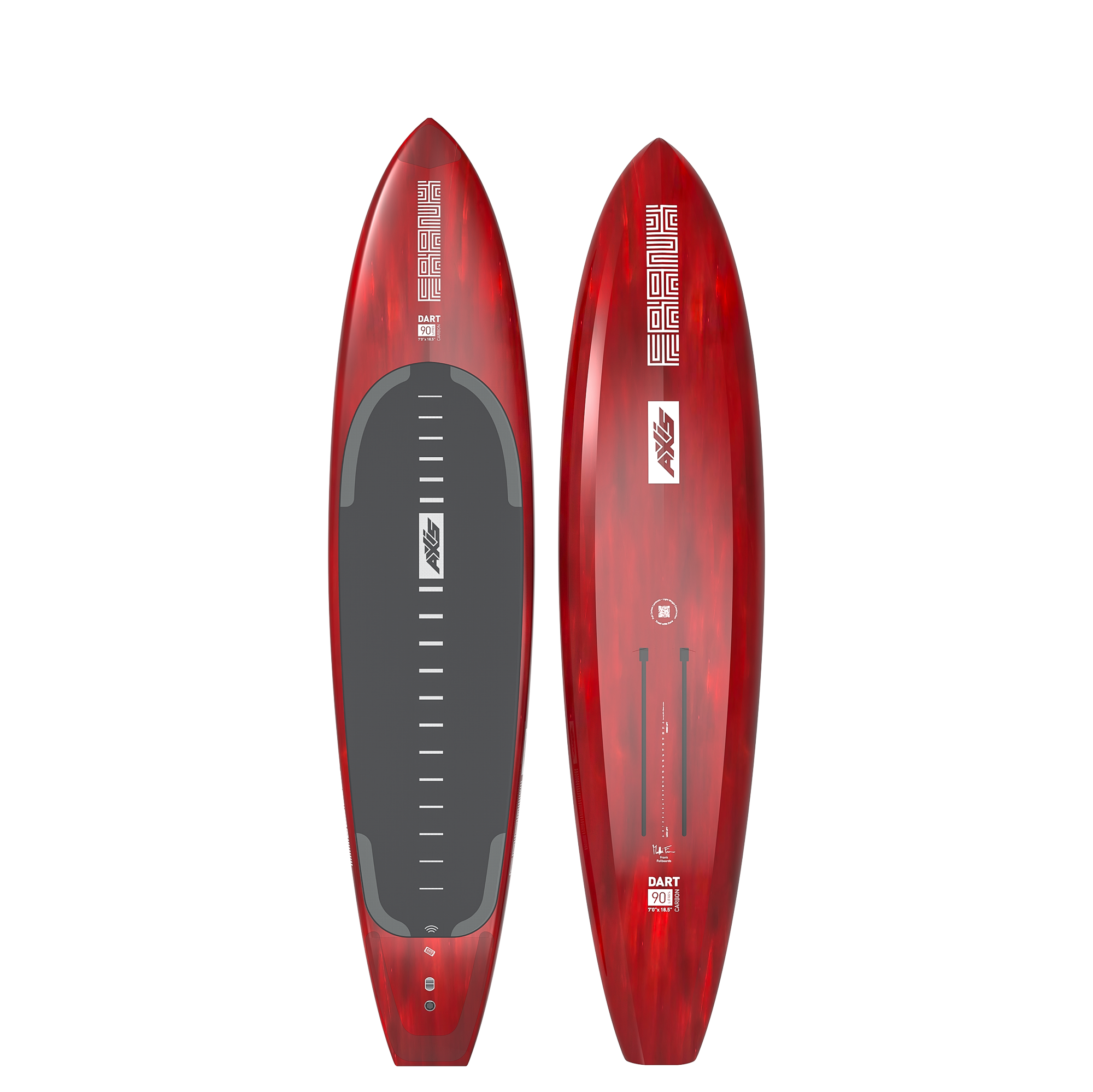
At a brand that makes only foils, the boards are for foiling too — and nothing else. Here is how they differ.
Six families
- Tray v4 / v5 — 857 to 875 €, volumes 96, 110, 125 l.
- Pump Foilboard — 952 to 1,049 €, volumes 24, 30, 37, 44 l.
- Foil Drive — 1,091 to 1,445 €, volumes 40 to 70 l. Built for an electric motor.
- Frank Mini Dart — 1,228 to 1,383 €, 50 to 80 l.
- Froth Carbon — 1,293 to 1,455 €, volumes 45 to 135 l. The widest family.
- Downwind Carbon — 1,602 to 1,645 €, 110 to 130 l.
- Frank Dart — 1,638 to 1,843 €, 100 to 130 l, lengths 7'2" to 7'8".
Plus the Prone 26 at 997 €, 4'1", the shortest board in the range.
How to read it: volume and length together
The key to the whole range lies in a pair of numbers rather than the names.
Look at the ratio of length to volume:
- Short and voluminous (Froth 90 l) — wing foiling: volume holds you before takeoff, short length stays out of the way in flight.
- Long and voluminous (Frank Dart 7'8" × 130 l) — downwind: length is what lets you accelerate on a swell without external thrust.
- Short and low volume (Prone 26, 4'1") — prone foiling: the board only has to get you to the wave.
- Very low volume (Pump 24 l) — pumping: volume hinders, as covered in our pump foil article.
The rule: volume says whether the board holds you at rest. Length says how you will accelerate.
Tray: why it is the cheapest
The Tray v4 and v5 cost 857 to 875 € — noticeably below the rest — with large volumes: 96, 110, 125 l.
High volume in a simple shape means a learner and light-wind board. It holds you in place while you work the wing and forgives start mistakes.
Note v4 and v5 in the catalogue together: two generations at one price. That is normal — an older generation does not get worse when a new one appears, and the difference is usually in shape detail. We covered the same logic in our model year article.
Froth: thirteen volumes in a row
The widest family: 45, 55, 65, 75, 85, 90, 95, 105, 110, 120, 135 litres.
A 10-litre step signals a mature range. Such fine spacing exists because the brand knows 10 litres are genuinely felt at the start.
Choosing a volume:
- Learning → your weight in kilograms plus 20 to 30. At 80 kg, 100 to 110 l.
- Flying confidently → roughly equal to weight. 80 kg → 75 to 85 l.
- Advanced → 20 to 30 % below weight.
A common mistake: buying low volume straight away "so as not to change in a year". You then spend a year unable to start, and the board still turns out wrong.
Dart and Mini Dart: what the shape means
A dart is a dart, and the shape follows: narrow and long. The Frank Dart comes in 7'2"×19", 7'4"×19.5", 7'6"×20", 7'8"×20.5".
Nineteen inches of width at 7'2" of length is a very narrow board. Standing still on it is nearly impossible.
Why that shape: downwind. You paddle prone or standing, accelerating on a following swell, and a long narrow board glides where a wide one stalls.
The Mini Dart — 5'6" to 6'0", 50 to 80 l. A compromise: the same proportions, shorter and more voluminous, for entering the discipline.
What all AXIS boards share
Carbon. Nearly every family carries Carbon Foilboard in the name. The reason is stiffness: in foiling your input travels from feet through board into mast, and a soft board eats part of the steering.
Mast inserts. Every board is built for a foil — there is no plain paddling board in the range.
Prices from 857 €. The brand has no cheap entry, and that is a deliberate position.
Choosing in under a minute
First wing foil board at 80 kg → Froth 105 or Tray 110.
Second season → Froth 85.
Prone foiling → Prone 26 (4'1") or a low-volume Froth.
Downwind → Downwind Carbon 120 or Frank Dart 7'4".
Moving into downwind → Frank Mini Dart 5'10" at 70 l.
Pumping → Pump Foilboard 30 or 37 l.
With an electric motor → Foil Drive 60 l; the discipline is in our separate article.
Common questions
How does Froth differ from Tray?
Tray is the learner and light-wind board with large volumes at a lower price. Froth is the main range in 10-litre steps from 45 to 135.
What volume at 80 kg?
100 to 110 l while learning, 75 to 85 once confident, less at advanced level.
What does Dart mean in the name?
A narrow, long downwind shape — 19 inches wide at 7'2" long.
Why are all the boards carbon?
In foiling your input travels from feet through board into mast, and a soft board eats part of the steering.
Can I buy low volume straight away?
Better not: you will spend a year unable to start, and the board will still be wrong once you can.
Where to look
Tray v5 110 866 €, Froth 85 1,357 €. The section: foil boards.
Mui Ne wind — right now
Live spot webcam and the wind sensor at the K1 station. Wind is on — book a lesson or rent gear.
Read next
Over three months we covered twenty brands and every watersport. Here are the patterns that recurred in every …
Every Watersport Discipline: A Map of Entry Barriers and BudgetsKiting, winging, windsurfing, SUP, surfing and foiling in all its forms — twelve disciplines in one map. Entry…
Quarter in Review: Twenty Brands, Twelve Disciplines and What FollowsThree months of reviews, from Ozone to Aquatone. What we learned about the equipment market, which conclusions…