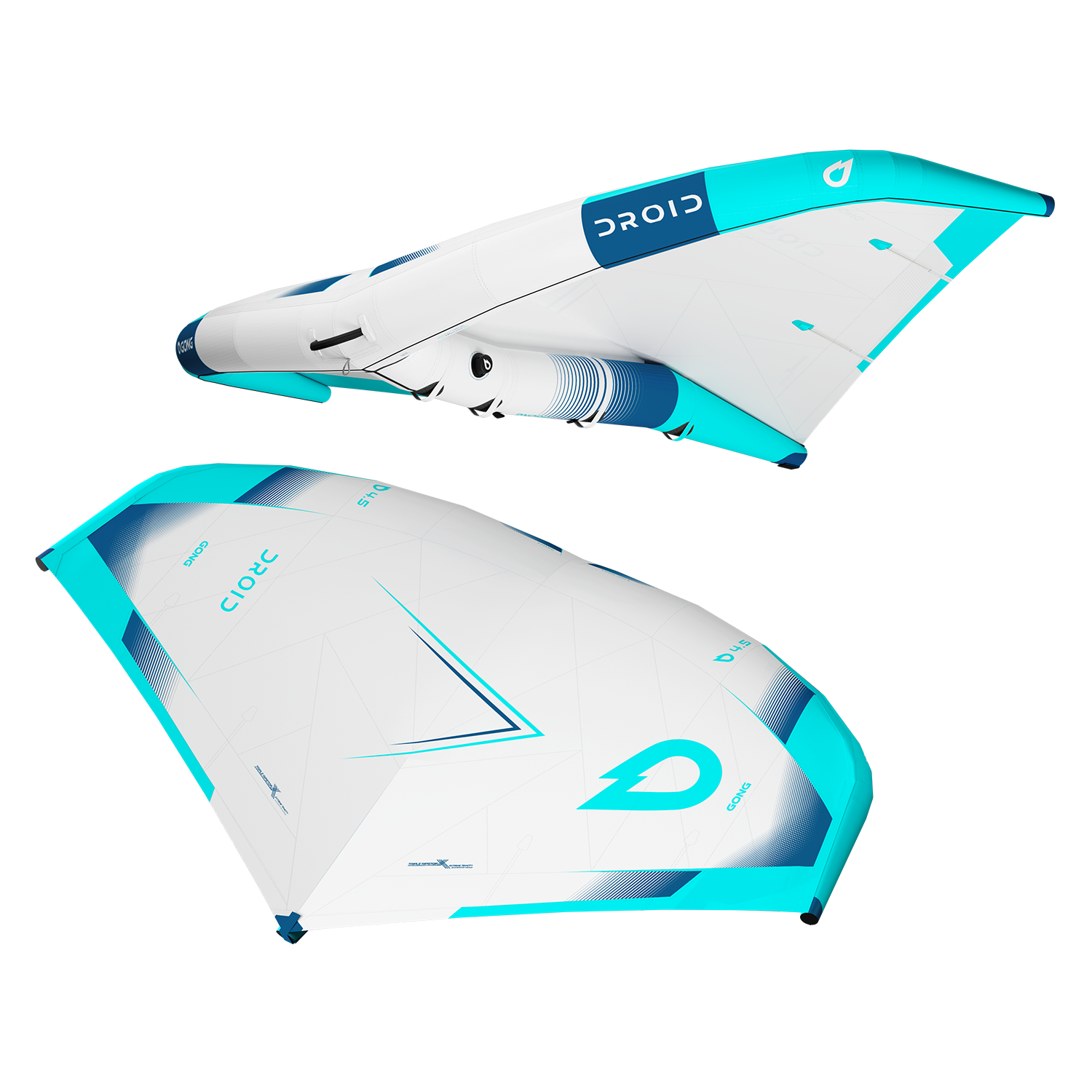
Twenty-three wing items from one brand is a lot. Here is the structure: there are really four models, multiplied across materials.
Four models
Neutra — from
495 €. Sizes from 2 m². A boom version exists.Droid — from
419 €. Sizes 2 to 4.5 m². A boom version exists.Pulse — from
379 €. Sizes from 4 m². The racing Aramid CZ version is 1 499 €.Plus —
629 €. Sizes from 4 m².How to read this range
The key is in the size ladders rather than the names.
Neutra and Droid start at 2 m². A two-metre wing means strong wind and a light rider. So these models cover the upper part of the range.
Pulse and Plus start at 4 m². That is the middle and lower end — models for lighter wind.
The practical conclusion: establish your working size by wind and weight first, and half the range drops away by itself.
Size guide: 5.0 m² at 70 to 85 kg as a single wing; under 65 kg, 4.5; over 90 kg, 5.5 to 6.0. More in our Starboard wings guide, where the logic is the same.
Materials: six versions of one model
This is what makes the range look large.
Take the Neutra:
- UPE Aramid —
A 224 € spread within one model — nearly half the base price.
The surprise: UPE Aramid comes in below plain Dacron. A good illustration that "dearer material" is not a linear scale — blends can be better value. On the materials themselves, see our canopy material guide.
How to choose: take Dacron as a first wing. Wing weight will not limit you until you ride regularly for two hours at a time.
Boom or handles
The Neutra and Droid come in boom versions, and the premium is symbolic —
10 €.A boom is a rigid tube along the wing: hands move freely and the grip sits exactly where you want it.
Handles are lighter and cheaper, but grip positions are fixed.
At a ten-euro difference the choice is clearer than usual: if in doubt, take the boom, especially while learning, when you do not yet know your stance.
A detailed comparison is in our separate article.
Separately: Pulse and the racing branch
A striking spread: the base Pulse DP at
379 €, the racing Pulse Aramid CZ at 1 499 €. Nearly fourfold within one name.What it means. The model exists both as the cheapest entry to the discipline and as racing equipment. All they share is geometry; everything else is different materials and different build.
The practical conclusion: do not choose a wing by model name. In this range the name describes the shape and the price says who the wing was built for.
Building a quiver
One wing: 5.0 m² in Dacron. It covers the mid-range wind you will learn in.
Two wings: 4.0 and 6.0. A two-metre gap means different days rather than shades of one.
Three wings: 3.5, 5.0, 6.5.
The classic mistake: buying a second wing half a metre below the first. You will not notice on the water and will simply have bought the same thing twice.
What else you need
A board. Inflatable HIPE from
299 € — covered here.A foil. The dearest part of the setup.
A wing leash. A released wing blows away instantly.
Helmet and vest. There is a metal wing underwater; this is not up for discussion.
Ready packages: GONG offers board-plus-wing packages from
959 €, and for entering the discipline that is often smarter than assembling piece by piece.Common questions
How many wing models does GONG actually have?
Four: Neutra, Droid, Pulse and Plus. The other items are the same models in different materials.
Which wing should I buy first?
5.0 m² in Dacron at 70 to 85 kg. Wing weight becomes a limit later.
Is the boom worth the premium?
It is about ten euros for a free grip. While learning, yes.
Why does the Pulse cost both 379 and 1,499 euros?
One geometry in different materials: a base entry point and racing equipment under one name.
How much smaller should a second wing be?
Two metres. You will not feel half a metre on the water.
Where to buy
379 €, Wing Droid 419 €, Wing Neutra 509 €. The section: wings.GONG Boom for wing Neutra at K1.surf
Genuine GONG gear. From 465 €. Our IKO instructors match the size to your weight, level and wind. Sold in Vietnam only.
Read next
The Harlem PEAK at 2,144, the Thrive LiteX at 2,794, the Ozone Edge Ultra-X at 2,819. What really sits behind …
Wake and Tow Foiling: Behind a Boat, With No Wind and No WavesWKT boards are built for towing behind a boat or a cable park. How it works, why the boards are so small, and …
Slingshot Brand Review: The Americans Who Built a Kite Without StrutsSlingshot is known for durability and unusual constructions — from the Code to the single-strut UFO. Seven cat…