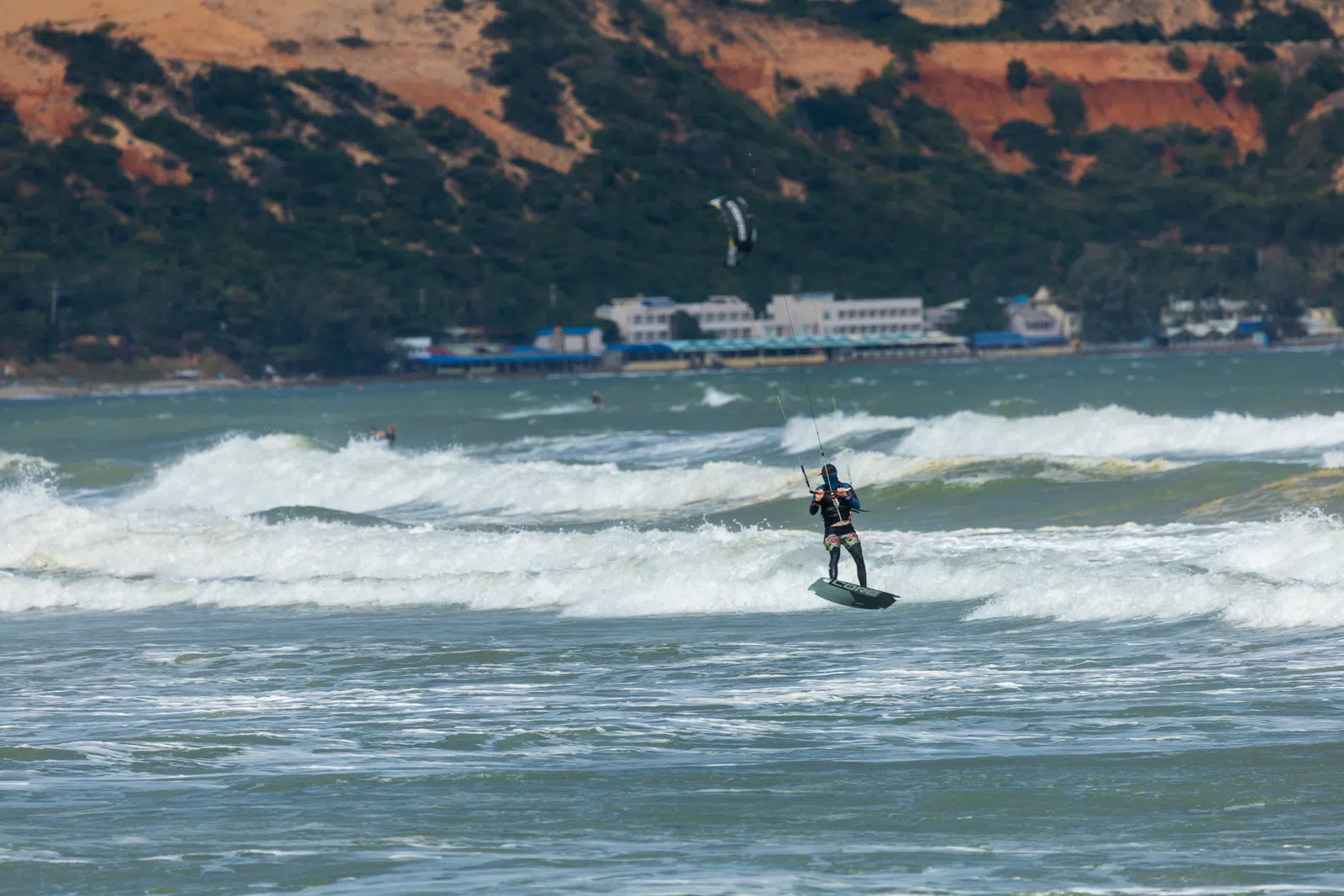
A waterspout is a rotating column of air over water, stretching from a cloud base down to the surface. Most are far weaker than a land tornado — and still strong enough to lift a kite, a board and the person attached to them.
They occur in exactly the conditions kiters like: warm water, unstable air, light shifting wind. Which is why this is worth knowing rather than filing under exotic.
How they form
The common type — the fair-weather waterspout — starts at the surface, not in the cloud. Warm water heats the air above it; that air rises into a developing cumulus; converging surface winds start it rotating, and the rotation tightens as the column stretches upward.
The tornadic type is the dangerous one: it descends from a thunderstorm, is far stronger, and behaves like a tornado that happens to be over water.
How to recognise one early
They announce themselves in stages, and the first stage is easy to miss:
- A dark spot on the water — a circular patch where the surface looks different. This is the rotation reaching the surface, before anything is visible in the air.
- A spiral pattern of light and dark bands spreading around that spot.
- A spray ring — water being thrown up in a circle. At this point it is a functioning waterspout even if you cannot see a funnel.
- The visible funnel, which is condensation, not water, and is the last stage rather than the first.
If you learn one of these, learn the dark spot. It gives you minutes that the funnel does not.
What to do
Get out of the water. Not later, immediately. A waterspout moves with the parent cloud and can change direction, so trying to judge whether it will pass is a bad use of the time you have.
Move at right angles to its path if you must move on the water. Never try to outrun one downwind.
Land and secure the kite — a kite left on the beach in the outflow becomes a projectile.
Do not photograph it from the water. Every year someone does.
Where and when they happen
Warm seas and unstable air: the tropics year-round, temperate coasts in late summer and autumn when water is warm and air masses start to cool. Southeast Asia sees them in the transitional months around the monsoon change.
They are usually short-lived — minutes rather than hours — and often occur in groups, so one waterspout means watch for a second.
Frequently asked questions
How strong is a waterspout?
Fair-weather spouts typically carry winds of 25–35 m/s in the column. That is more than enough to overpower any kite. Tornadic ones are far stronger.
How far away is safe?
There is no reliable number, because they move and change. Treat any visible waterspout as a reason to be off the water and off the beach until it dissipates.
Can I see one coming on radar or an app?
Generally no. They form and dissipate faster than forecast models resolve. Your eyes and the dark spot on the water are the warning system.
Are they common on kite spots?
More common than riders expect, precisely because kite spots are warm, shallow and windy places. Ask local instructors — most have seen at least one.
Conditions and the live webcam for our beach are on the wind page. Reading weather is part of the theory in every kitesurfing course we run.
Want advice from an instructor?
Our IKO instructors will help you choose gear or plan a kite trip to Mui Ne — free of charge.
Read next
Starboard came out of windsurfing and became the leading name in SUP. The range: inflatable and hard boards, p…
Inflatable SUP vs Hard Board: What to Choose and the Real DifferenceAn inflatable fits in a boot; a hard board goes faster. Eight differences you feel on the water, and when payi…
How to Read a SUP Board Size: 10'8" x 33", Litres and What MattersThree numbers — length, width and volume — decide whether you paddle or fall. What each one means and how to m…