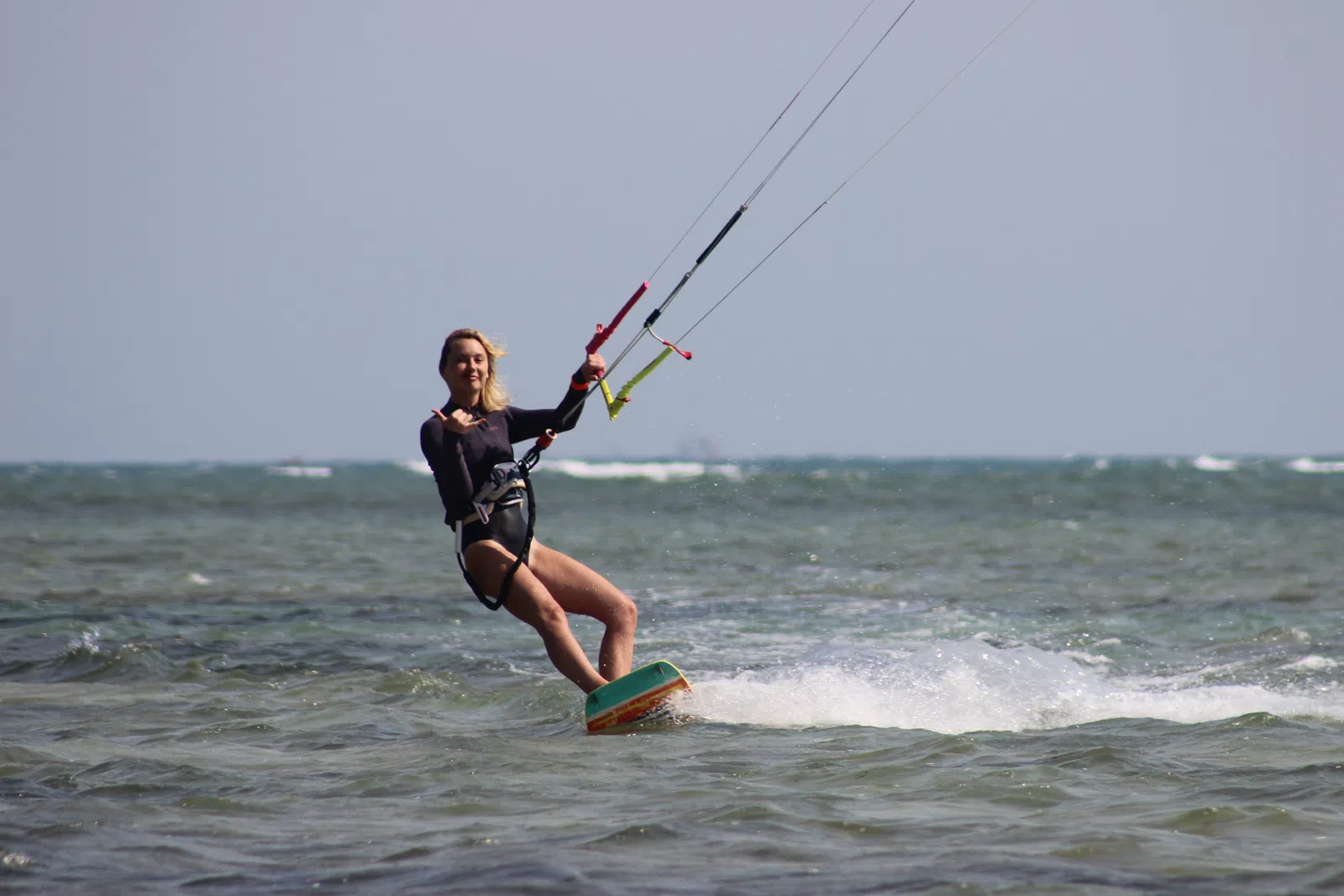
A beginner in the tropics thinks about wetsuits and not about the sun. Two days later they cannot put a harness on — their back is burned. Here is how to avoid that.
Why the sun hits harder on the water
Three factors compound, and together they roughly double what you get on a beach.
One: reflection. Water reflects part of the ultraviolet upward, so you receive a dose from above and below.
Two: you cannot feel it. Wind and water cool the skin, so the familiar "burning" signal never fires. You notice the burn in the evening.
Three: duration. A session is two to four hours straight during the most intense part of the day, because wind usually blows from midday.
The conclusion: in the tropics sun protection is not cosmetic but the condition of riding for a week rather than two days.
Rash guard versus sunscreen
Sunscreen works, but:
- It washes off within 40 to 80 minutes in water, even water-resistant kinds.
- Reapplying on the water is impossible.
- You cannot cover your own back properly.
- Some formulations harm coral, and at certain spots that is already regulated.
A rash guard does not wash off, run out or need reapplying. That does not mean "instead of sunscreen" — face, hands and feet still need cream. But it covers 80 % of your body reliably.
The practical conclusion: rash guard as the base, sunscreen for the exposed parts.
What UPF means
UPF (Ultraviolet Protection Factor) is a fabric rating, the cloth equivalent of SPF.
UPF 50+ means the fabric transmits less than 2 % of ultraviolet. That is the standard for water apparel.
An important subtlety: an ordinary cotton T-shirt gives roughly UPF 5 to 7, and less once wet. In other words, riding in a T-shirt is close to riding in nothing.
Second: protection depends on weave density and colour. Dark and dense protects better than light and loose.
Long sleeves or short
Short: cooler and freer at the shoulders. Shoulders and forearms are exposed — precisely the places that burn first.
Long: covers the arms entirely. For kiting and winging that matters: your arms are raised and turned towards the sun all session.
Our advice for Mui Ne and any tropics: long sleeves. The discomfort of extra fabric is nothing beside burnt forearms.
On legs — the part people forget
The backs of the legs and the hollows behind the knees burn most often. Simple reason: you stand facing the wind with the sun behind you, and you cannot see those areas at all.
What helps: longer shorts or lycra leggings.
And separately, feet. The tops of the feet burn to blisters, after which you cannot wear shoes for a week. Cream there is mandatory, reapplied before every session.
Head, eyes, lips
A cap, under a helmet or alone. In our catalogue Aztron caps start at
9 €.Floating sunglasses —
4 €. They do not sink. A small item that repays itself once.Lips. Light reflected off the water hits the lower lip and it cracks. An SPF lip balm solves it.
Do you need a wetsuit in the tropics?
The honest answer: usually not, but sometimes yes.
When you do not: water at 27 to 29 degrees and sessions under two hours. A rash guard is enough.
When a thin suit (1 to 2 mm) or a top helps:
- Long sessions. Even in warm water three hours in the wind will chill you.
- Morning sessions. Water warms up by midday.
- Harness protection. Neoprene under a harness stops chafing — one of the main reasons people wear a top in 28 degrees.
- Jellyfish and coral. A thin layer of fabric prevents stings and grazes.
Choosing thickness and type: our separate article.
A tropics checklist
- A long-sleeved rash guard, UPF 50+ — the base.
- Sunscreen on face, neck, hands and feet — before every session.
- A cap — ashore and on the water.
- Floating sunglasses.
- SPF lip balm.
- Reef boots if the bottom is rocky.
- A top or thin wetsuit for long sessions or harness chafing.
Common questions
Why is the sun worse on the water?
Water reflects ultraviolet upward, wind cools your skin so you do not feel the burn, and sessions last hours during peak intensity.
Is sunscreen enough instead of a rash guard?
No: it washes off within 40 to 80 minutes and cannot be reapplied on the water. Rash guard as base, cream for exposed areas.
What does UPF 50+ mean?
The fabric transmits under 2 % of ultraviolet. An ordinary T-shirt gives about UPF 5 to 7, and less when wet.
Do I need a wetsuit in 28-degree water?
Usually not. But a top or thin suit helps on long sessions, against harness chafe and against jellyfish.
What burns most often?
The backs of the legs, behind the knees, and the tops of the feet — the places you cannot see facing the wind.
What to read next
How to choose a wetsuit, our Aztron review, and lessons in Mui Ne.
Try kitesurfing in Mui Ne
A trial hour with an IKO instructor is €55, all gear included. Then a course to independent riding or a December kite camp.
Read next
Inflatable kayaks for one, two or three, a SUP-kayak hybrid, and floating platforms up to twenty feet. A branc…
A SUP at 200 and at 1,400 Euros: What Differs on the WaterA sevenfold price gap between outwardly similar boards. What actually changes, point by point, and the three c…
Red Paddle Co Brand Review: Premium Inflatable SUP and What You Pay For31 boards from 1,000 to 1,751 euros, paddles to 175, and a pump with its own spare hose. What sits behind a pr…