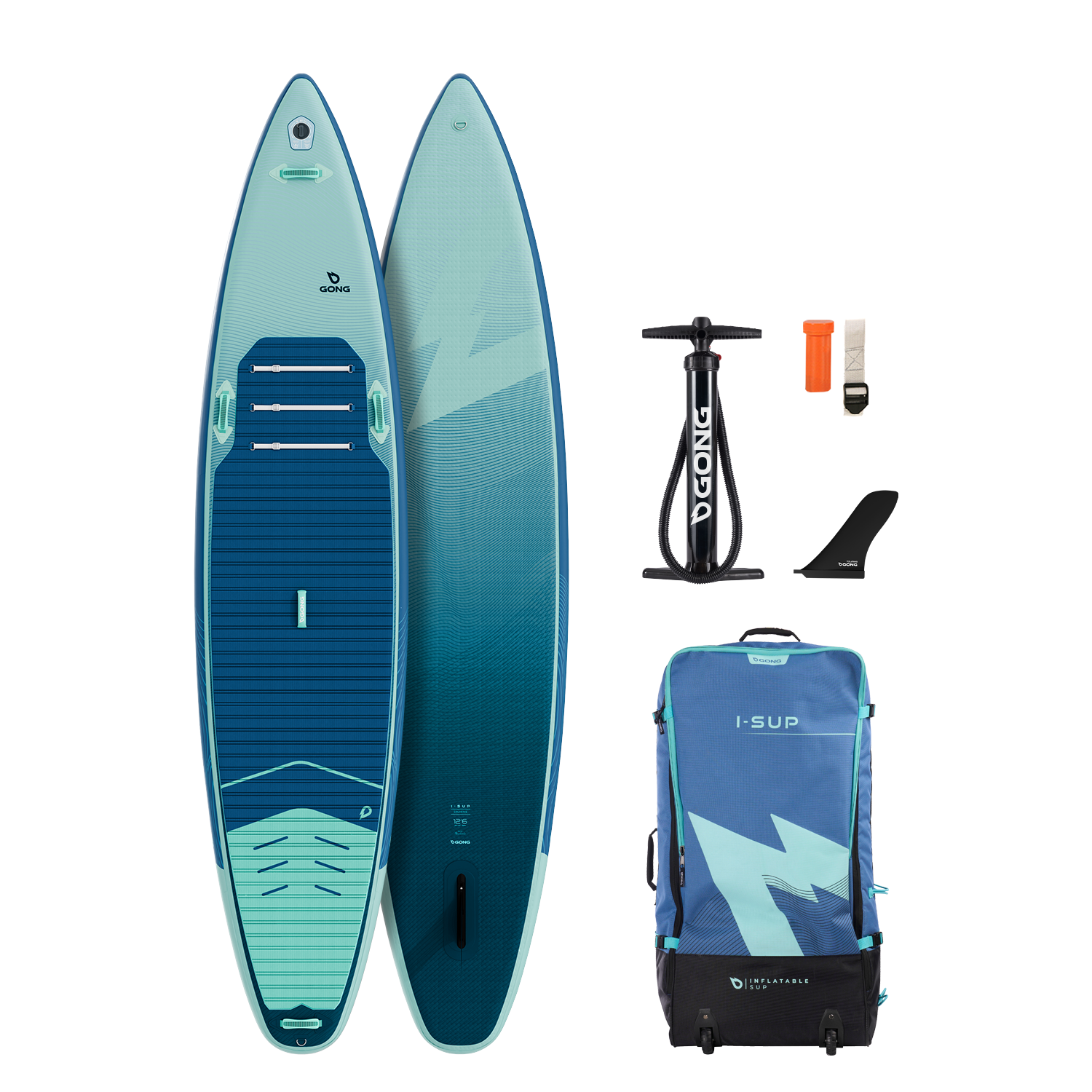
Nine models between 399 and 769 euros. Here is how they differ — the names describe the job more honestly than usual.
The range
- Hybrid —
How to read it: three groups
Nine names reduce to three scenarios, after which the choice becomes simple.
Group 1: short, under 10 feet
Shortboard, Hybrid, Longboard, Allround, Do it.
All-rounders and wave boards. Manoeuvrability over speed, riding near shore, an hour or two at a time.
Group 2: long, 11 to 14 feet
Cruising, Explorer, Adventure, Family.
Distance and touring. They hold a course, carry gear, and are built for several hours.
Group 3: racing
Race and Race Flat Water.
Narrow: 26 to 30 inches against 32 to 34 on all-rounders. On what narrowness costs, see our touring versus racing comparison.
What the widths in Race mean
A neat detail: on the racing model, width appears in the variant itself — 12'6 x 26, x 28, x 30.
That is unusual and helpful. Width normally hides in a description; here it is in the variant name and you see your step immediately.
How to choose:
- 30" — a first race board while you learn to stand on narrow.
- 28" — standing confidently, entering events.
- 26" — racing seriously.
Separately, the Race Flat Water 18' at
769 €. Eighteen feet is 5.5 metres, a board purely for flat water and maximum straight-line speed.Family and Explorer: two different ideas of "for two"
A subtlety worth understanding before buying.
Family — 12'0, 13'5 and even 15'. Wide and voluminous, built for several people at once.
Explorer and Adventure — 12'6 to 14'. Long but narrow: they carry one person plus gear rather than two people.
The difference is fundamental: two people on a board means two load points and a different balance. A board designed for one person with a rucksack behaves differently under two adults.
Practical advice: planning to carry a child at the front, buy Family. Planning solo overnight trips, buy Explorer or Adventure.
Choosing in under a minute
First board, calm water → Allround 10'6.
Over 90 kg → Allround 11'6 or Cruising 11'6.
Two- to three-hour cruises → Cruising 12'6.
Touring with gear → Explorer or Adventure 14'.
Carrying a child → Family 12'0.
Racing, first year → Race 12'6 x 30.
Waves → Shortboard 8'5.
No idea → Allround. The name is honest.
On volume and weight
A universal rule across the range: litres no lower than your weight in kilograms, and twice that for a beginner.
Length then affects glide and width affects stability. The full treatment is in our SUP size guide.
A common mistake: buying long, assuming length brings stability. Width brings stability. A long narrow board is less stable than a short wide one.
Common questions
Which model should I buy first?
Allround 10'6 for calm water, 11'6 above 90 kg. The model name is honest here.
How does Family differ from Explorer?
Family is wide and built for several people. Explorer is long and narrow — one person plus gear.
What width in the Race?
30 inches for a first race board, 28 once you stand confidently, 26 for serious competition.
What does length give, and what does width?
Length gives glide and tracking, width gives stability. A long narrow board is less stable than a short wide one.
How many litres do I need?
No fewer than your weight in kilograms, and twice that as a beginner.
Where to buy
449 €, Cruising 459 €, Race 519 €. The section: inflatable SUP.GONG at K1.surf
Genuine GONG gear. Our IKO instructors match the size to your weight, level and wind. Sold in Vietnam only.
Read next
AXIS offers a four-component configurator rather than a finished foil. How to choose in the right order, which…
Foil Etiquette: Why Foilers Are Unpopular and How to Fix ItA metal wing underwater is invisible, and that is the root of every conflict at a spot. The rules that formed …
Electric Assist for Foiling: A Motor You Run for Twenty SecondsFoil Drive and Assist put a compact motor on the mast to get you up to takeoff speed. How it works, what it co…