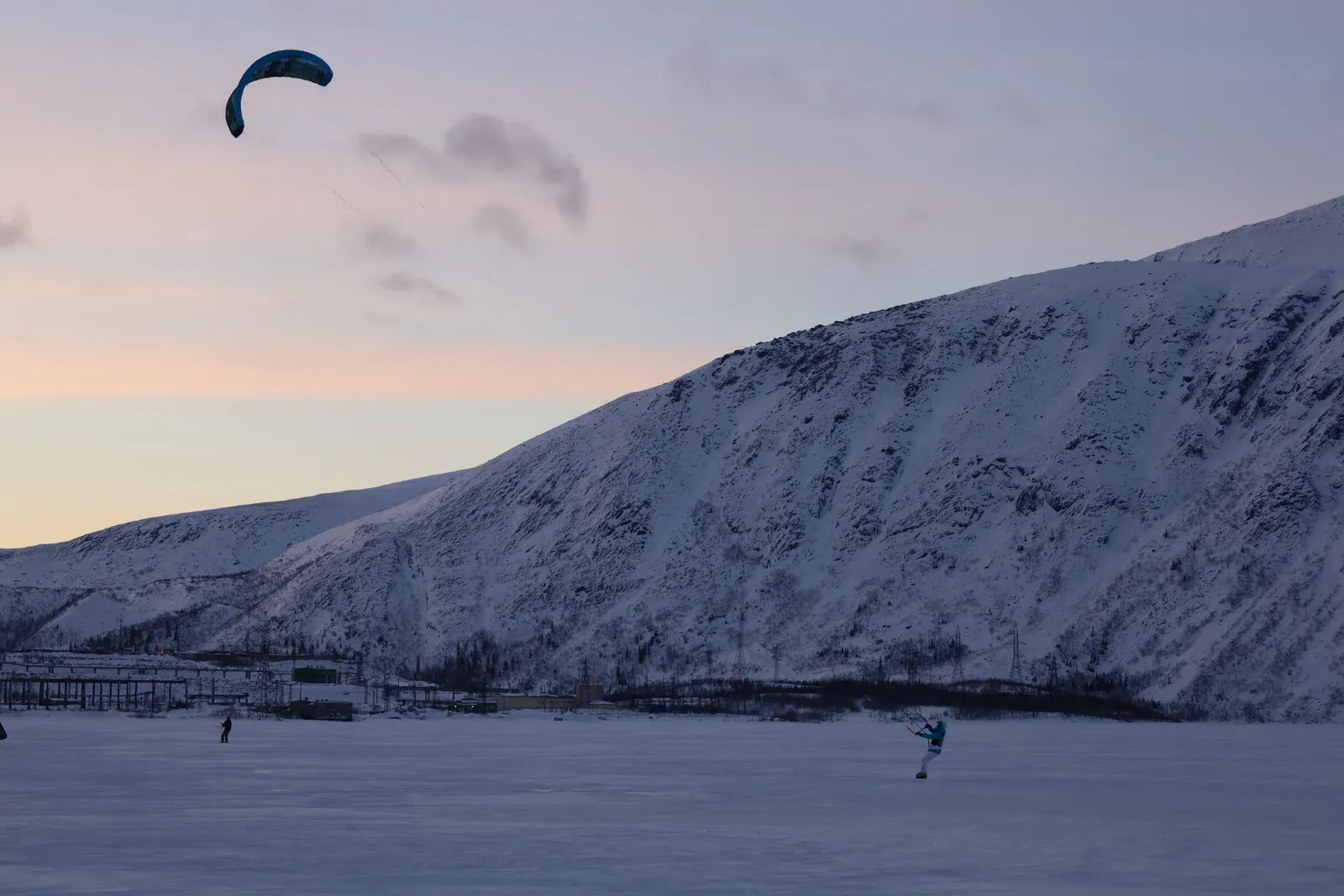
Most snowkiters picture the Alps. The Russian Arctic is a different proposition entirely: no lifts, no crowds, no trees — a white plain running to the horizon with the Barents Sea on one side and the Khibiny mountains to the south.
We run winter trips here. This is what the place is actually like, from someone who has been cold in it.
Where it is
Teriberka is a village on the Barents Sea coast, about 150 km from Murmansk, and the best known of the northern spots since a film made it famous. Around it are other riding areas — Tumanny, Kirovsk, Monchegorsk — most of them frozen lakes and open tundra.
Murmansk itself is reachable by air or by train from Moscow and St Petersburg, and everything after that is a drive.
How cold is it, honestly
Colder than home, and less brutal than the legends. The saving detail is the sea: the Barents Sea stays around +2–3 °C even in February and works as a giant radiator for the coastal strip. Inland Russia at the same latitude is far harsher.
The ideal temperature for riding is −6 to −15 °C. In that band the snow does not melt even in sunshine and the glide is fast. Between 0 and −3 °C the surface goes slushy in the sun, which is heavy and slow. In the coldest winters the region drops to −30 °C, but that is not the usual working range.
When to come
January, February and March hold the right conditions. From April the snow melts during the day and refreezes at night, leaving an icy crust — fast, but unforgiving in a fall.
One thing to plan around: the polar night. The sun does not rise at all for several weeks in December and early January. Riding happens in a long blue twilight, which is beautiful and limits your hours. By late February the days are long enough for a full session.
What the riding is like
Flat, endless and empty. There are no obstacles to hit and no queues for anything, which means you can ride kilometres in a straight line, and that is exactly what people come for. Distance riding — covering ground across the tundra rather than doing tricks in one place — is the discipline the north is built for.
Wind is generally steady and open, without the turbulence you get in a mountain valley. Snowkiting is also easier to learn than water kiting: you are standing on a solid surface from minute one, and a fall is into snow.
What you need
Snowkiting gear is specific: depower kites with snow-appropriate bars, skis or a snowboard, and above all clothing that survives wind chill at −15 °C. Goggles, not sunglasses. A face covering. Spare gloves, because wet gloves at that temperature end a session immediately.
We provide kites and safety equipment on our trips; you bring your own skis or board and your own clothing, because fit matters more than anything else you own out there.
Northern lights
It would be dishonest to leave this out, because it is half the reason people come. Teriberka sits well inside the aurora zone, and on clear nights in winter the sky performs. It is not guaranteed — nothing atmospheric ever is — but a week in February gives you good odds.
Details of our winter trips and what is included are on the snowkiting page (Russian). If you are considering joining from abroad, write to us — we will be straight with you about logistics, visas and what the cold actually means day to day.
Want advice from an instructor?
Our IKO instructors will help you choose gear or plan a kite trip to Mui Ne — free of charge.
Read next
The iGO is Starboard's best-selling board: several sizes, inflatable and hard versions, a package with paddle …
Touring vs All Star: A Touring SUP and a Racing SUPBoth boards are long and both are fast, but the jobs differ. How 14'0"×30" differs from 14'0"×24.5", and why a…
Starboard Brand Review: SUP, Windsurfing and Foils — 200 ProductsStarboard came out of windsurfing and became the leading name in SUP. The range: inflatable and hard boards, p…